Avoid a Collision with Collusion: an Academic Integrity Module Embedded in a First-year Cell Biology Subject
Ann Parkinson1, Eva Hatje1,2, Mary Kynn3 and Nicole Reinke1
1 School of Health and Behavioural Sciences, University of the Sunshine Coast
2 School of Biomedical Science, Faculty of Health, Queensland University of Technology
3 Institute of Applied Health Sciences, University of Aberdeen, UK
Students entering university do not always have a clear understanding of academic integrity or the standards expected in higher education. Some arrive with study habits that do not meet university requirements and may engage in academic misconduct without recognising that their behaviour is inappropriate.
Developing an understanding of academic integrity is important not only for successful university study but also for the professional responsibilities students will encounter after graduation.
In 2017, an incident involving collusion in a second-year Physiology subject at the University of the Sunshine Coast highlighted the need to introduce academic integrity education earlier in students' university experience.
At that time, the university did not provide a formal academic integrity education program. In response, we developed our own teaching modules and introduced them in 2018 within Cell Biology, a first-year subject delivered during students' first semester.
The aim was to strengthen students' understanding of academic integrity and equip them to make informed decisions when completing assessment tasks.
Developing Academic Integrity Modules
We developed three sequential academic integrity modules based on examples of dishonest academic practices that students might encounter while completing Cell Biology assessments.
Each module included multiple-choice questions presenting situations directly relevant to the subject's assessment requirements.
By using realistic assessment scenarios, the modules encouraged students to consider how academic integrity principles applied to decisions they might make during their own studies.
Feedback was provided after each module, before students submitted the relevant assessment task. This feedback was delivered through classroom discussions or narrated videos.
The feedback also introduced real-world examples of professional dishonesty, reinforcing the importance of acting with integrity beyond university.
This approach helped students connect the expectations of academic integrity with ethical responsibilities they would encounter in their future careers.
Understanding Collusion and Legitimate Collaboration
Student responses revealed an important distinction between recognising obvious forms of academic misconduct and understanding the boundaries of acceptable collaboration.
Most students could identify examples of cheating, fraud and contract cheating. However, many experienced difficulty recognising collusion.
This difficulty was particularly evident in scenarios involving students working with friends or family members.
Collaboration is an essential skill in science, and students should be encouraged to develop the ability to work effectively with others. However, academic staff must also ensure that an individual's assessment grade accurately reflects their own work.
The challenge is therefore to distinguish clearly between legitimate collaboration and unauthorised cooperation on work that students are required to complete independently.
To help students understand these boundaries, we developed a Statement of Legitimate Collaboration.
This statement explained which collaborative behaviours were acceptable and which constituted collusion for particular assessment tasks.
Providing explicit guidance helped students recognise that activities permitted during laboratory work or group discussions may not necessarily be appropriate when preparing individual assessment submissions.
The importance of this distinction is illustrated in Figure 1, which presents an interactive scenario involving students who collected laboratory data together and subsequently discussed aspects of an individually assessed task.
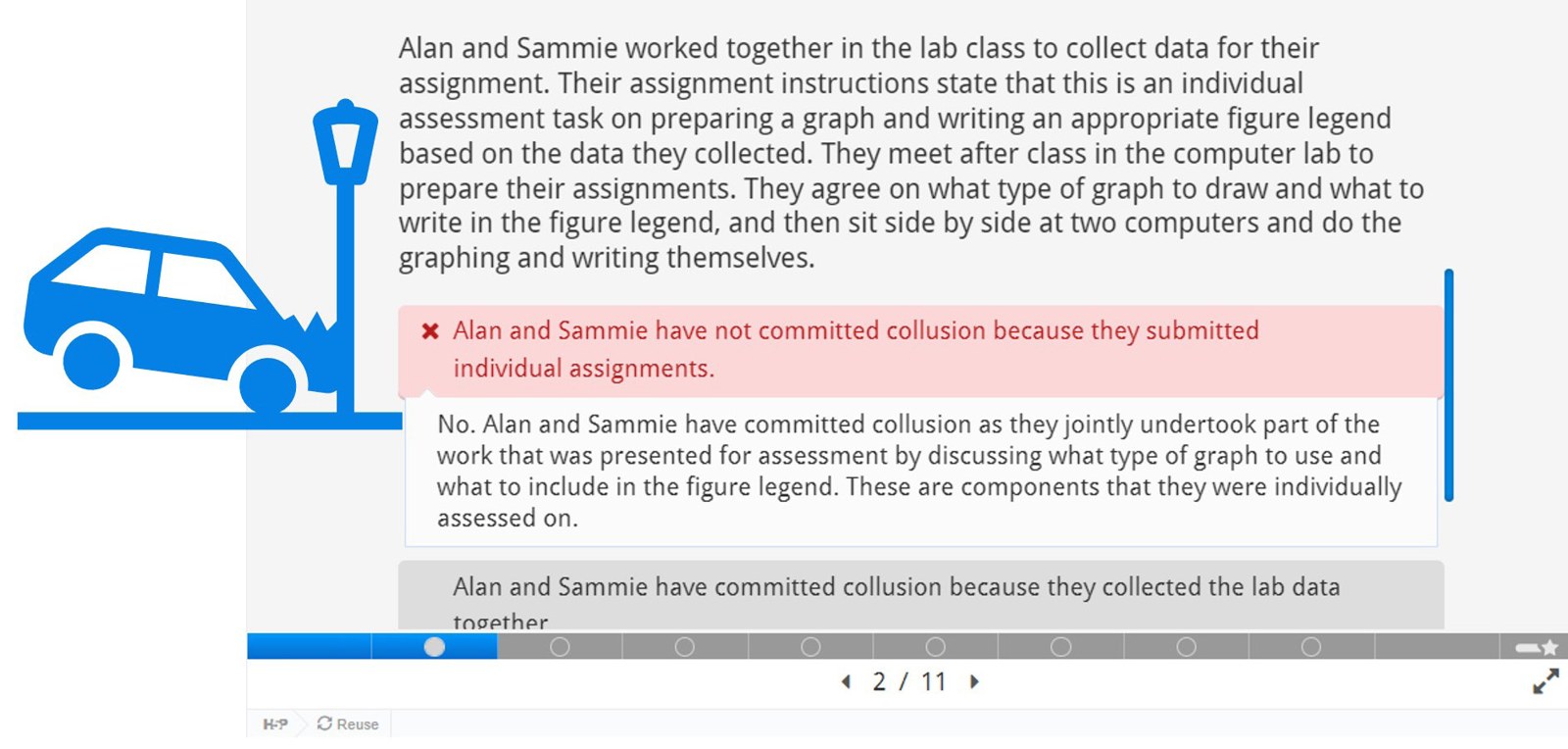
Fig. 1. Example of the Academic integrity module in the H5P platform, showing a scenario-based question with incorrect response and feedback.
Student Feedback and Evaluation
At the end of the semester, students were invited to complete an anonymous survey evaluating their experiences with the academic integrity modules.
Most respondents reported feeling confident that they could apply what they had learned about academic integrity to their future university studies and professional activities (1).
Student feedback particularly highlighted the value of practical examples, clarification of responsibility in different scenarios and connections between university learning and professional conduct.
These responses indicated that the modules helped students understand academic integrity as a practical responsibility rather than simply a set of university rules.
The feedback also reinforced the importance of presenting students with realistic situations and opportunities to discuss why particular actions were acceptable or inappropriate.
Refining and Extending the Modules
Following the initial implementation in 2018, the modules were refined in response to student feedback and used again in Cell Biology during 2019 and 2020.
In 2021, the scenario-based questions were updated to reflect changes made to the subject's assessment tasks.
The academic integrity materials were also adapted for use in a second-year Physiology subject, extending the initiative beyond the original first-year cohort.
Separate interactive modules were subsequently created using H5P software, allowing students to engage with scenario-based questions and receive feedback through a digital learning environment.
Our ongoing goal is to provide repeated opportunities for students to develop their understanding of academic integrity throughout their studies.
Rather than treating academic integrity as a topic addressed only once at the beginning of university, we believe students benefit from revisiting these principles as they encounter new subjects, assessment formats and collaborative learning activities.
Regular discussion also provides opportunities for students to seek clarification about expectations that may differ between assessment tasks.
Our experience demonstrates that students need explicit, assessment-specific guidance about legitimate collaboration to understand how to avoid collusion.
By embedding academic integrity education within subjects and linking it to authentic assessment scenarios, educators can help students develop the knowledge and confidence needed to act with integrity during their studies and in their future professional careers.
Reference
- Parkinson AL, Hatje E, Kynn M, Kuballa A, Donkin R, Reinke NB. Assess Eval High Educ 2022; In print. DOI: 10.1080/02602938.2022.2040947 .
About the authors

Clockwise from top left: Ann Parkinson, Eva Hatje, Mary Kynn and Nicole Reinke.
Dr Ann Parkinson is a Teaching and Research Academic in the School of Health and Behavioural Sciences at the University of the Sunshine Coast.
aparkins@usc.edu.au
Dr Eva Hatje is a Teaching Academic in the School of Biomedical Science, Faculty of Health, at the Queensland University of Technology.
e.hatje@qut.edu.au
Dr Mary Kynn is a Teaching and Research Academic in the Institute of Applied Health Sciences at the University of Aberdeen, United Kingdom.
mary.kynn@abdn.ac.uk
Dr Nicole Reinke is a Teaching and Research Academic in the School of Health and Behavioural Sciences at the University of the Sunshine Coast.
nreinke@usc.edu.au
This article first appeared in the ASBMB Education Feature of Australian Biochemist Vol 53 No 1, April 2022, pages 14–15.
ASBMB Membership Office
T +61 (03) 9907 8648
E asbmb@wsm.com.au
© 2026 ASBMB. All rights reserved.