ChemBraille: 3D Chemical Models for the Vision Impaired
Aaron Oakley
University of Wollongong
The importance of visual and spatial thinking in chemistry is illustrated by the famous account of August Kekulé, who described a dream involving a snake biting its own tail as inspiration for the ring structure of benzene. Molecular models have long helped students understand the three-dimensional arrangements of atoms and chemical bonds.
However, conventional molecular modelling kits generally distinguish elements using colour, making them less accessible to students who are blind or have impaired vision. After teaching two visually impaired students in second-year university chemistry subjects, I developed ChemBraille, a system of tactile three-dimensional molecular models designed to communicate chemical information through touch.
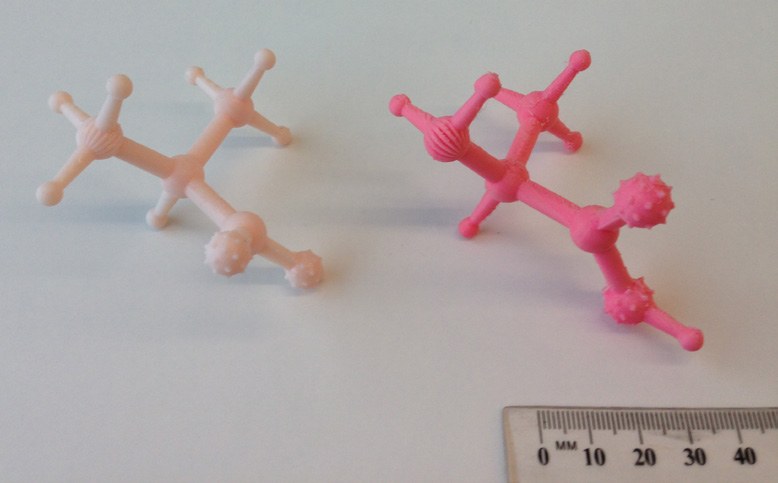
Fig. 1. Printed ChemBraille models of L-alanine. Ruler shown for scale.
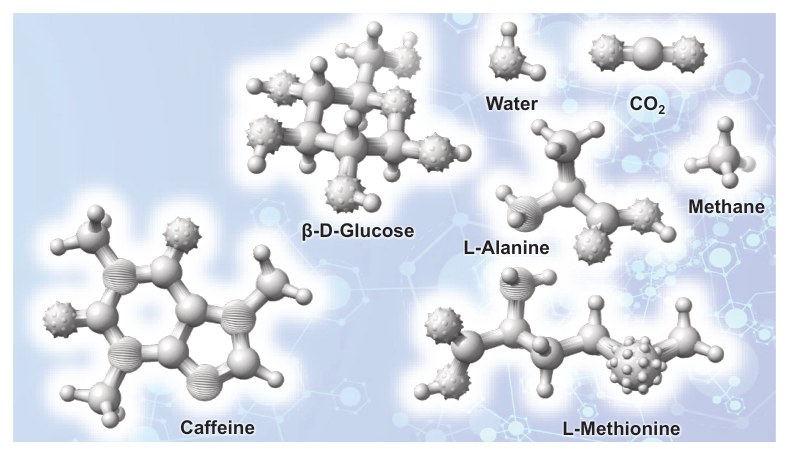
Fig. 2. Computer rendering of ChemBraille models of biologically relevant compounds.
ChemBraille uses widely available chemical structure files to produce inexpensive, tactile molecular models. In principle, the system can be used to create a three-dimensional representation of any organic compound.
The process begins with chemical table files, a family of text-based file formats containing information about the atoms within a molecule, their bonds, connectivity and spatial coordinates.
A Python script called sdf2scad converts these chemical files into scripts for OpenSCAD, a program that generates three-dimensional computer models. OpenSCAD then produces an STL file, a standard format used in computer-aided design and 3D printing.
The resulting STL file can be imported into 3D-printer software to manufacture the physical model.
In ChemBraille models, spherical shapes represent atoms, while connecting rods represent chemical bonds. Rather than relying on colour, different elements are distinguished by their surface textures.
The system provides unique tactile patterns for ten elements: boron, carbon, nitrogen, oxygen, fluorine, phosphorus, sulfur, chlorine, bromine and iodine. Each texture is designed to be distinguishable through touch.
Chemical bond order is communicated through the cross-sectional shape of the connecting rods. Single bonds have a circular profile, double bonds have a square profile and triple bonds have a hexagonal profile.
Together, these features allow students to identify elements, explore molecular geometry and distinguish bond types without relying on visual information. Figure 1 shows a printed ChemBraille representation of the amino acid L-alanine.
For biochemistry teaching, I have produced models of several biologically important molecules, including amino acids, nucleic acid bases and simple sugars. Examples of the computer-generated designs are shown in Figure 2.
ChemBraille model sets have also been developed for secondary school and university chemistry education. One example is a functional group collection containing representative organic compounds with groups such as aldehydes, ketones, esters and amines.
This collection is available through the Harvard Dataverse , allowing educators to access models suitable for teaching common organic chemistry concepts.
Initial student feedback has been encouraging. One visually impaired second-year student expressed that access to the models would have been particularly useful during their first year of study.
Although ChemBraille was developed to improve accessibility for blind and visually impaired students, its benefits are not limited to those groups. Sighted students can also use the tactile representations to investigate molecular structures and chemical bonding.
Another practical advantage is that ChemBraille models can be manufactured using common, relatively inexpensive single-colour 3D printers. Because the chemical information is encoded through texture and shape, multicolour printing is unnecessary.
Unlike conventional molecular modelling kits, which are limited by the number and types of physical components supplied, ChemBraille allows educators to generate complete models of a wide range of molecules without needing to assemble them from a fixed collection of parts.
ChemBraille therefore offers an accessible and flexible approach to molecular modelling that can support students with different learning needs while broadening opportunities for hands-on exploration of chemical and biochemical structures.
About the author
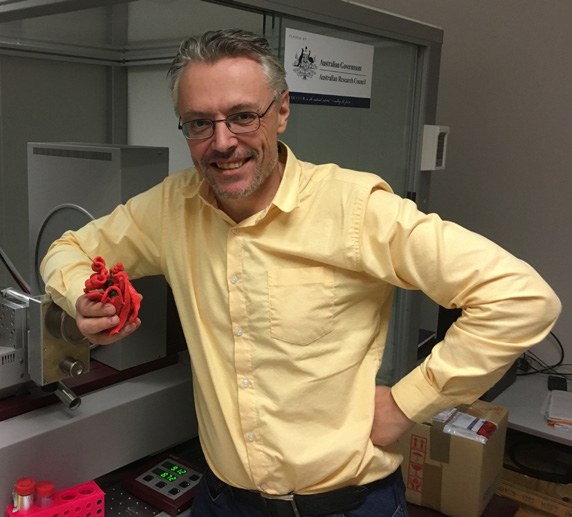
Associate Professor Aaron Oakley is a structural biologist in the School of Chemistry and Molecular Bioscience at the University of Wollongong.
aarono@uow.edu.au
This article first appeared in the ASBMB Education Feature of Australian Biochemist Vol 54 No 2, August 2023, page 19.
ASBMB Membership Office
T +61 (03) 9907 8648
E asbmb@wsm.com.au
© 2026 ASBMB. All rights reserved.