Development of a Metacognitive Mindset to Improve Student Learning in Biochemistry
Kathryn Jones
University of Auckland, New Zealand
Metacognition refers to the ability to plan, monitor and evaluate one's own learning and performance. It plays an important role in successful university study by helping students recognise how effectively they are learning and identify opportunities for improvement (1).
The transition to online teaching during the COVID-19 pandemic required students to adapt quickly to unfamiliar digital learning environments. At the University of Auckland, metacognitive skills had not previously been explicitly incorporated into much of the biology curriculum.
To address this, we introduced activities designed to encourage students to reflect on their learning approaches throughout the upper-level biology curriculum, beginning with a second-year biochemistry course enrolling approximately 400 students.
From 2020, reflective questions were incorporated into existing fortnightly formative module quizzes. Each quiz contributed 1% towards the course grade and included an H5P learning module containing ten interactive biochemistry questions.
An additional written reflection encouraged students to consider how they were studying, whether their strategies were effective and what changes might improve their performance.
Questions addressed five aspects of metacognitive thinking: learning strategies, monitoring progress, planning, evaluating performance and motivation.
For example, students were encouraged to identify their approaches to preparing for tests, assess whether those approaches helped them achieve their goals and consider practical steps they could take to manage their time more effectively.
Responses were automatically marked using keywords, limiting additional marking requirements for teaching staff. Incorporating the reflections into existing graded quizzes helped establish their importance, with an average completion rate of 94%.
How did we introduce such questions?
On the first day of the course, students participated in a Slido poll asking them to consider their experiences from previous semesters and identify what they could do to improve their learning.
Their responses appeared in a live word cloud, providing an immediate overview of common challenges and priorities. Time management emerged as a particularly prominent concern.
The activity encouraged students to recognise that many of their peers experienced similar difficulties. It also provided teaching staff with useful insights into students' study habits, including challenges associated with distractions and late-night activities.
Although live polling can be engaging in a large class, it also requires some trust that students will provide appropriate responses.
In Week 2, the monitoring-themed quiz asked students to identify how they intended to act on the improvements they had proposed during the initial poll.
Anonymised student responses were reviewed and common themes discussed during class. This created opportunities for students to learn from one another by sharing approaches such as productivity applications, time-management tools and flashcards.
In Week 4, students reflected on their planning and revision strategies in preparation for an upcoming test.
Following the release of test results, the Week 6 quiz focused on performance. Students were asked to evaluate how successful their preparation strategies had been and what they could do differently for future assessments.
Study strategies reported by high-achieving students were shared anonymously through Canvas, allowing the wider cohort to consider approaches that had proved effective for their peers.
Interestingly, students across the achievement spectrum were generally able to identify clear ways to improve their learning, regardless of the grades they had received.
In Week 8, the reflective activity turned to motivation. Students considered why they were undertaking their studies and what would help them remain engaged and committed to achieving their goals.
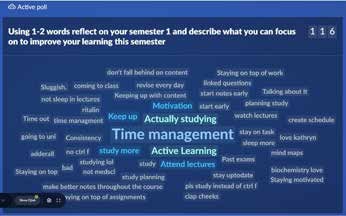
Fig. 1. Word cloud generated in Slido showing student responses for how they can improve their learning. Larger words represent more common responses.
What did students learn from their reflections?
Through repeated reflection, students developed a greater understanding of the differences between effective and less effective study strategies.
For example, actively testing their knowledge and constructing mind maps were recognised as more powerful approaches than simply rereading highlighted notes.
Many students came to appreciate that developing a deeper conceptual understanding was more valuable than relying primarily on memorisation.
For some, this realisation prompted changes in their revision practices, including greater use of concept mapping to connect and organise biochemical knowledge.
Several recurring themes emerged from student reflections. Students recognised the importance of self-regulation while acknowledging that managing their time, attention and study habits remained challenging.
They also identified learning as a social process and reflected on the loss of informal peer interaction during periods of online teaching.
This prompted interest in digital tools that could support collaborative learning and help students maintain connections with their peers.
Another emerging trend was a shift from traditional paper-based revision materials towards digital, text-based notes and online study resources.
Students also offered thoughtful recommendations for future cohorts. Selected advice was recorded as audio messages and shared with the following year's students, providing a personal connection between successive groups of learners.
Overall, incorporating metacognitive reflection into existing formative assessments provided a practical and scalable way to encourage students to think more critically about their learning.
The experience demonstrated that students can develop the ability to monitor their progress through measures other than grades alone, including their understanding, motivation, study habits and capacity to adapt their approaches.
By supporting students to plan, evaluate and adjust their learning strategies, educators can help them become more independent and effective learners.
Reference
- Tanner KD. CBE Life Sci Educ 2012;11(2):113–120.
About the author

Dr Kathryn Jones is an education-focused academic in the School of Biological Sciences at the University of Auckland, New Zealand.
ks.jones@auckland.ac.nz
This article first appeared in the ASBMB Education Feature of Australian Biochemist Vol 54 No 1, April 2023, pages 12–13.
ASBMB Membership Office
T +61 (03) 9907 8648
E asbmb@wsm.com.au
© 2026 ASBMB. All rights reserved.