Empowering Students Through Curriculum Choices and Assessment Design: A Students as Partners Approach That Enhances Engagement and Assessment Literacy
Chris Love
Griffith University
After more than 18 years teaching biochemistry and molecular biology, I became increasingly concerned about students' reluctance to participate in classroom problem-solving activities. Some students explained that they felt embarrassed or feared being judged by their peers if they provided an incorrect answer. This reluctance often resulted in limited classroom discussion and participation.
While exploring ways to address this challenge, I attended a Students as Partners (SaP) workshop at Griffith University, facilitated by higher education consultant Mick Healey. The workshop introduced me to an approach that positions students as active collaborators in designing and developing their learning experiences (1,2).
Inspired by the possibilities, I began planning changes to my second-year Protein Science course, Advanced Biochemistry, which enrols approximately 120 students. I wanted to provide meaningful opportunities for students to influence both the curriculum and assessment activities.
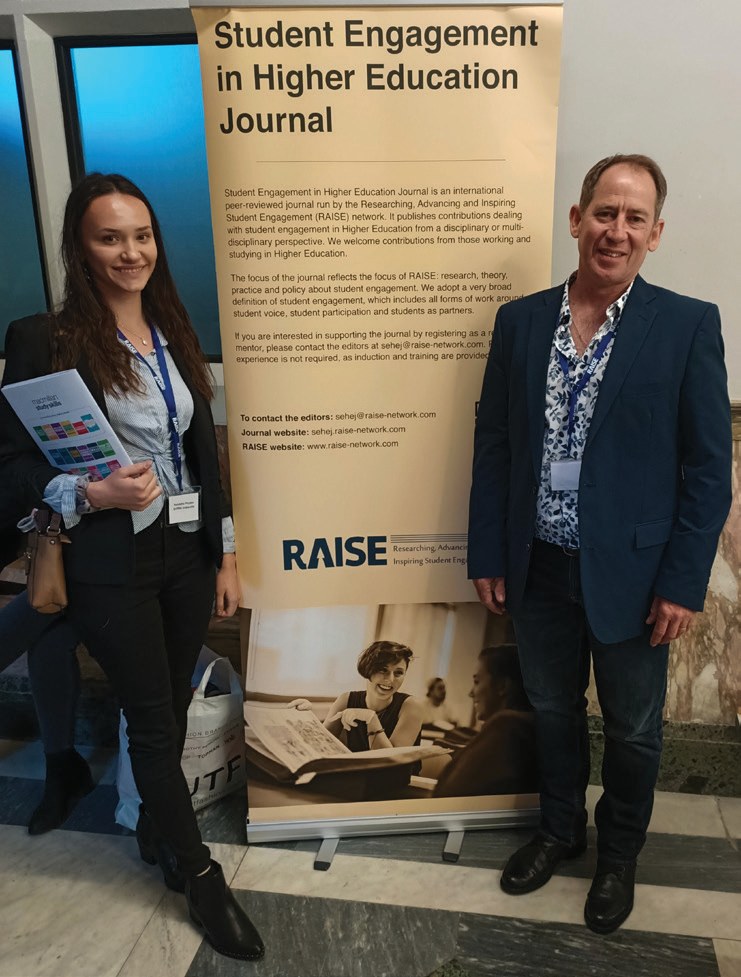
Chris and student partner, Natalyha Phister, at the RAISE Conference.
Students as Partners strategy and considerations
The SaP initiative was designed to establish a collaborative learning environment in which students felt included, empowered and able to contribute meaningfully to decisions about their education.
The approach was informed by five principles of genuine student–staff partnership (3), emphasising active participation, shared responsibility, dialogue and reflection. My central objective was to encourage students to take greater ownership of their learning and increase their engagement with the course.
Three activities formed the foundation of the partnership:
- Curriculum choice: Students selected a topic they wished to study from four options: proteomics, protein therapies, protein–DNA interactions and protein engineering.
- Assessment co-creation: Students developed multiple-choice questions with guidance and scaffolding. They also negotiated how many student-generated questions would be included in the formal assessment.
- Safe learning environment: PebblePad, a personal learning environment, was used to provide a supportive space for completing partnership activities and reflecting on learning experiences.
Partnership outcomes
Student participation and feedback exceeded my initial expectations. Among participating students, 80.5% reported that their involvement in curriculum design and assessment development had increased their engagement. Of these, 32% described themselves as engaged and 48.5% as more engaged.
Student reflections provided valuable insights into why these activities were effective. When selecting topics, students frequently considered their future academic studies, research ambitions and personal interests.
Some students selected topics because of their relevance to future careers, while others appreciated being able to study an area of biochemistry that particularly interested them. The opportunity to exercise choice was itself an important source of motivation.
Designing multiple-choice questions presented a different set of challenges. Students found that creating plausible incorrect answers was particularly difficult and required a deeper understanding of the subject matter.
Through this process, students recognised that writing effective assessment questions required them to identify gaps in their own knowledge, distinguish between closely related concepts and consider how questions are constructed.
Their reflections suggested that participating in assessment design could also improve their ability to interpret and answer multiple-choice questions in future assessments. This aligns with research indicating that student involvement in assessment development can strengthen assessment literacy (4).
The feedback also demonstrated the value of giving students a genuine role in shaping their education. Students described feeling more involved in the course and more interested in the material because their choices influenced what they studied.
One particularly important outcome was students' recognition that developing assessment questions encouraged them to reflect on what they understood, what remained unclear and where further learning was needed.
The initiative also created opportunities for undergraduate students to collaborate with me on research examining the Students as Partners approach. Student partners obtained funding to attend and co-present our findings at the Researching, Advancing & Inspiring Student Engagement (RAISE) Conference in Newcastle, United Kingdom, in 2019.
During the COVID-19 pandemic, the partnership approach helped maintain meaningful connections with students despite disruptions to conventional teaching. I have continued using the strategy and remain encouraged by the level of engagement and ownership students demonstrate when they are genuinely involved in their learning.
References
- Healey M, Flint A, Harrington K. Engagement Through Partnership: Students as Partners in Learning and Teaching in Higher Education. 2014, Advance HE.
- Cook-Sather A, Bovill C, Felten P. Engaging Students as Partners in Learning and Teaching: a Guide for Faculty. 2014, Josey-Bass.
- Matthews KE. Int J Students Partners 2017;(2):1–9.
- Deeley S, Bovill C. Assess Eval High Educ 2015;42(3):463–477.
About the author

Dr Chris Love is an Associate Professor in the School of Environment and Science at Griffith University.
c.love@griffith.edu.au
This article first appeared in the ASBMB Education Feature of Australian Biochemist Vol 54 No 3, December 2023, pages 22–23.
ASBMB Membership Office
T +61 (03) 9907 8648
E asbmb@wsm.com.au
© 2026 ASBMB. All rights reserved.