Fixing the Kinks in the COIL of Work Integrated Learning
Jessica Borger¹,²,³, Megan Taylor¹,² and Kyoko Hombo⁴
¹Walter and Eliza Hall Institute of Medical Research
²Department of Medical Biology, University of Melbourne
³Central Clinical School, Monash University
⁴Osaka University, Osaka, Japan
Preparing graduates for professional life requires educational experiences that connect academic learning with real-world challenges. Problem-based learning, authentic assessment and work integrated learning (WIL) help students develop practical capabilities, critical thinking and problem-solving skills. Increasingly, graduates must also be equipped to collaborate effectively across cultures and international boundaries (1–4).
Open pedagogical approaches, including WIL, provide opportunities for students to apply their learning within authentic contexts rather than developing skills in isolation (5). However, conventional WIL activities do not always address the challenges of international teamwork.
Digital technologies have created new opportunities for universities to connect students and educators across countries. The widespread adoption of online collaboration during the COVID-19 pandemic accelerated these possibilities and highlighted the importance of intercultural communication and virtual teamwork.
Collaborative Online International Learning (COIL) provides a framework for students to develop disciplinary, professional and intercultural skills through collaborative activities involving institutions in different countries.
We explored this approach through the Translational Medicine and Biomedical Entrepreneurship Collaborative Online International Learning (TMedBiomE-COIL) PhD program, developed jointly by Monash University and Osaka University. The program demonstrates how international collaboration and purposeful educational design can strengthen work integrated learning.
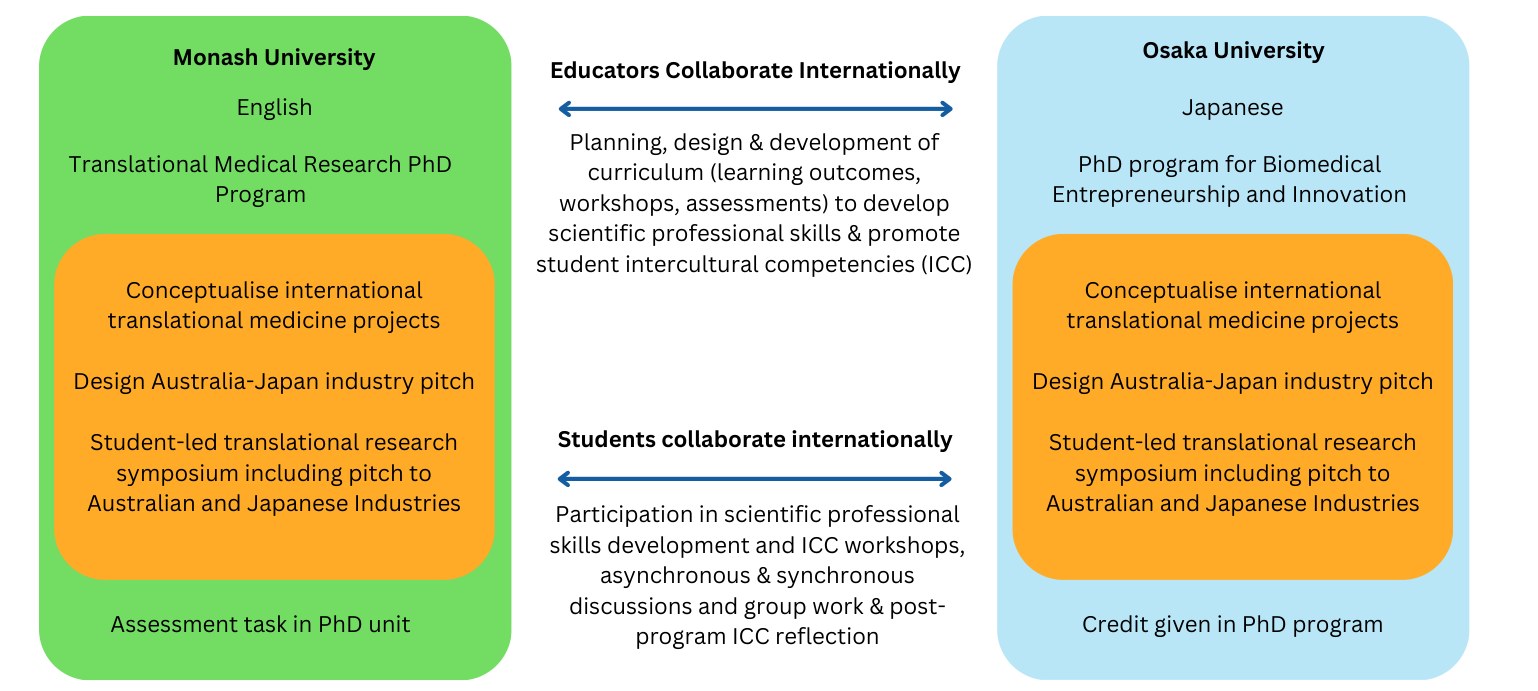
Fig. 1. TMedBiomE-COIL pilot program between Monash University and Osaka University. A shared syllabus was developed within the COIL program of the Translational Medical Research PhD program at Monash University and the PhD program for Biomedical Entrepreneurship and Innovation at Osaka University (TMedBiomE-COIL) to support both educators and students in international collaboration, development of skills and enhancement of intercultural competencies.
The TMedBiomE-COIL initiative connected Translational Research PhD students at Monash University with students studying Biomedical Entrepreneurship and Innovation at Osaka University. Participants collaborated through synchronous and asynchronous online activities, allowing them to exchange scientific perspectives while developing professional skills.
The program was incorporated into the Monash curriculum as a required activity, while Osaka University students received corresponding academic credit.
A jointly developed syllabus included workshops delivered by both universities. Monash University focused on scientific poster design and presentation, while Osaka University provided training in pitching scientific concepts to industry.
Working in small international groups, students developed translational medicine project proposals intended for pharmaceutical industry audiences in Australia and Japan.
Participants compared healthcare priorities and pharmaceutical industry environments in the two countries. They subsequently presented their ideas during a student-led symposium that considered scientific innovation, research enterprise and market opportunities.
These activities provided an authentic professional context in which students could apply scientific knowledge, practise communication and develop an understanding of the international biomedical research environment.
A central objective of the program was the development of intercultural competencies (ICC). These encompass the knowledge, attitudes and skills required to communicate and collaborate appropriately across cultural differences (6).
To prepare students for international groupwork, three intercultural development activities were integrated before the scientific WIL activities commenced.
The first was a 'Where were you?' icebreaker, in which students discussed significant years and experiences in their lives. This encouraged participants to recognise how cultural, geographical and personal backgrounds shape individual perspectives.
Students also completed the DISC® leadership assessment and an intercultural conflict style inventory. These activities encouraged reflection on personal leadership approaches, communication preferences and responses to disagreement, while considering how these characteristics may differ between cultures.
The activities were designed to reflect the realities of international research teams, where effective collaboration depends on understanding differences in leadership, communication and conflict resolution.
Post-program survey findings indicated that participants experienced increased confidence in intercultural groupwork (Fig. 2a). Students also reported improved awareness of cultural differences and potential barriers to collaboration (Fig. 2b).
Furthermore, students indicated greater confidence in adapting their communication approaches to accommodate cultural differences (Fig. 2c).
Together with additional unpublished findings, these results suggest that COIL initiatives can provide valuable opportunities for developing inclusive and equitable approaches to international teamwork.
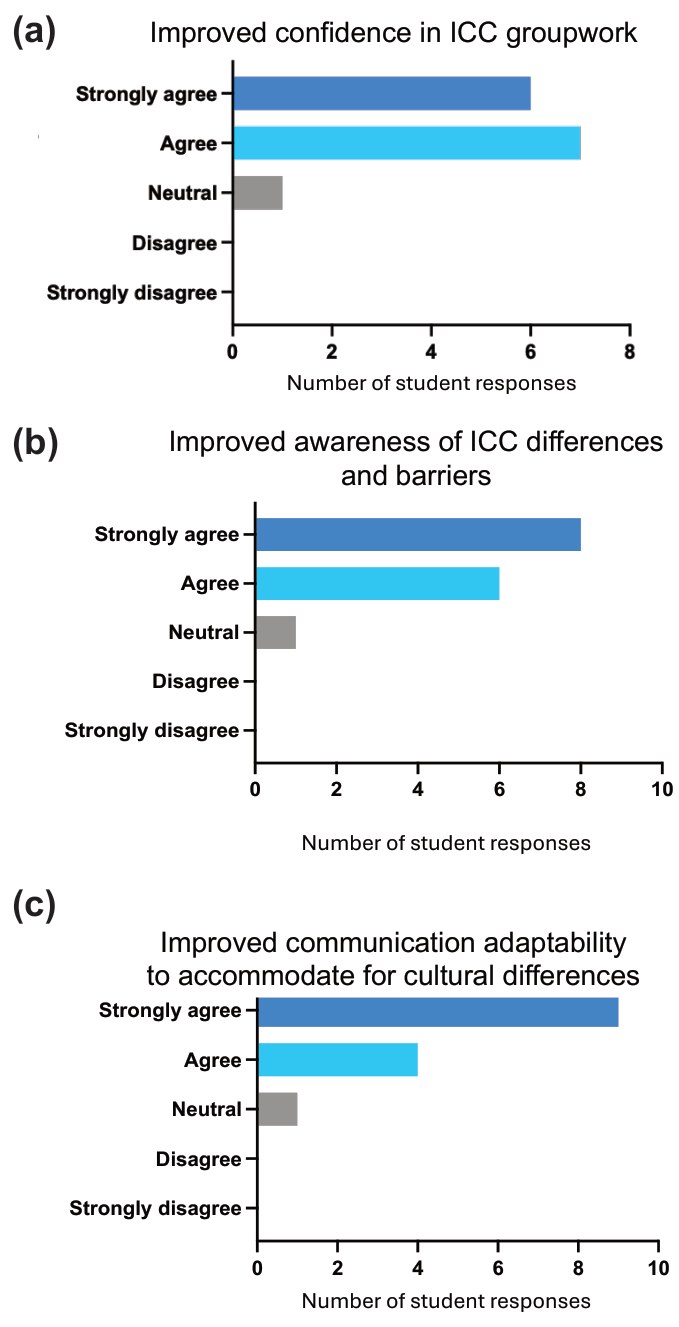
Fig. 2. COIL workshops to teach ICC improved students' abilities to participate in group work within virtual global classrooms. Post-survey data from Monash and Osaka University demonstrated that following participation in the COIL program students had (a) improved confidence in approaching ICC groupwork, (b) improved student awareness of and ability to identify differences and barriers in intercultural group work and (c) improved communication adaptability to accommodate cultural differences.
The TMedBiomE-COIL program illustrates how an international virtual learning experience can combine scientific training with the development of interpersonal and intercultural capabilities.
Preparing postgraduate science students for global healthcare and biomedical research careers requires more than providing opportunities to work alongside people from different backgrounds. Educational programs must actively develop awareness of cultural differences and provide strategies for effective communication, leadership and conflict resolution.
International partnerships, student mobility and deliberate integration of intercultural competencies can support this goal (7–9). Simply creating diverse student groups is insufficient without structured activities that help students understand and navigate intercultural collaboration (7,10–13).
COIL programs offer an accessible approach to internationalising the curriculum while retaining the practical, authentic learning experiences central to WIL. By integrating scientific collaboration with intercultural development, such programs can help prepare graduates to contribute effectively, inclusively and equitably within the global biomedical workforce.
References
- DeFillippi R, Wankel C. Real-world projects and project based pedagogies. In: DeFillippi R, Wankel C (eds). Educating Managers Through Real-world Projects. 2005. Information Age Publishing.
- Morley DA, Golam Md. Real world learning – recalibrating the higher education response towards application to lifelong learning and diverse career paths. In: Morley DA, Golam Md (eds). Applied Pedagogies for Higher Education. 2020. Palgrave Macmillan.
- Slaviša R, Firssova O, Hummel HGK, Vermeulen M. Stud High Educ 2020;46(12):2710–2725.
- Jopp R. Teach High Educ 2020;25(8):942–958.
- Johnston S, Stewart B. Int J Stud Partners 2020;4(2):81–89.
- Deardorff DK. J Stud Int Educ 2006;10(3):241–266.
- Charles H, Plager KA. Internationalising nursing education from the ground up: the case of Northern Arizona University. In: Green W, Green C (eds). Critical Perspectives on Internationalising the Curriculum in Disciplines. 2015. Brill Sense.
- Stütz A, Green W, McAllister L, Eley D. J Stud Int Educ 2015;19(1):28–45.
- Pan A, Ryan M, Cain J. Curr Pharm Teach Learn 2015;7(4):551–555.
- Bird EL. J Int Stud 2017;7(2):329–346.
- Gemmell I, Harrison R, Clegg J, Reed K. Innov Educ Teach Int 2015;52(2):137–147.
- Volet SE, Ang G. High Educ Res Dev 1998;17(1):5–23.
- Leask B. J Stud Int Educ 2013;17(2):103–118.
About the authors
Dr Jess Borger is the Scientific Education Program Leader at WEHI and the Graduate Course Coordinator at the Department of Medical Biology, University of Melbourne.
borger.j@wehi.edu.au
Dr Meg Taylor is the Scientific Education Specialist at WEHI and Masters Coordinator at the Department of Medical Biology, University of Melbourne.
taylor.me@wehi.edu.au
Dr Kyoko Hombo is an Associate Professor in the Institute for Transdisciplinary Graduate Degree Programs, Osaka University, Japan.
hombo.itgp@osaka-u.ac.jp
This article first appeared in the ASBMB Education Feature of Australian Biochemist Vol 55 No 2, August 2024, pages 21–23.
ASBMB Membership Office
T +61 (03) 9907 8648
E asbmb@wsm.com.au
© 2026 ASBMB. All rights reserved.