Getting the ‘VIBE’ in Biochemistry Education (Virtual Reality In Biochemistry Education)
Anna Lohning¹, Susan Hall², Oladayo Folasire¹, Ryan Wirth¹ and Shai Anoopkumar-Dukie²
¹Bond University
²Griffith University, Queensland
Changes in higher education have encouraged educators to investigate emerging technologies that may improve student engagement and understanding. In this article, we describe our experience incorporating three-dimensional (3D) technologies, including virtual reality (VR), into a second-year undergraduate biochemistry course.
Our research was undertaken over four years, from 2020 to 2023, and focused on an essential learning objective in biochemistry: understanding the relationship between biomolecular structure and function.
Students enter biochemistry courses with increasingly varied backgrounds in chemistry, mathematics and visual literacy. These differences can make it challenging to develop the spatial reasoning skills needed to interpret molecular structures.
Molecular diagrams are generally presented in two dimensions, yet students must mentally manipulate these representations to understand the three-dimensional characteristics of biomolecules. This is a fundamental skill in biochemistry, but one that can be difficult for some students to develop (1–3).
Improving these visualisation skills can support students' understanding of how molecular structure influences biological function (4). We therefore developed guided workshops incorporating different 3D technologies to help students explore these concepts through active learning.
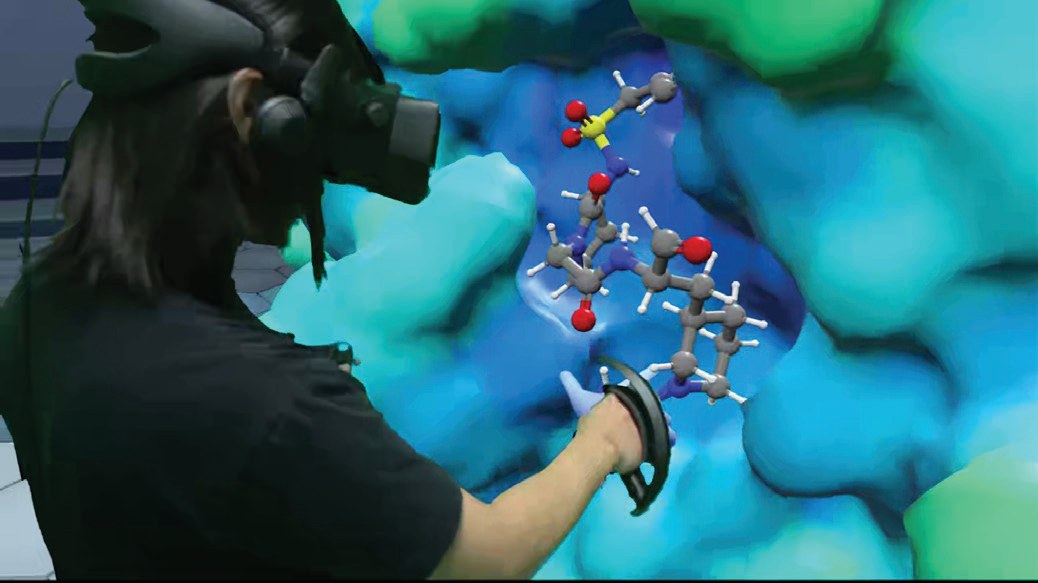
Fig. 1. Student probing the drug–protein interaction using Nanome (5) and Oculus headset.
Our ethically approved research invited students to participate in a one-hour workshop linked to a summative assessment on protein structure. Participation remained relatively low across the four years: seven students in 2020 (9%), four in 2021 (7%), twelve in 2022 (16%) and nine in 2023 (10%).
Workshop activities centred on a protein–drug interaction involving human sialidase (Protein Data Bank structure 4ncs.pdb) bound to 2,3-difluorosialic acid. The same molecular system was explored using three different approaches: physical 3D printing, computer-based molecular visualisation and immersive VR.
Our VIBE (Virtual Reality In Biochemistry Education) workshops allowed students to handle a 3D-printed protein model, manipulate molecular structures on a computer using FirstGlance in JMol, or experience an immersive molecular environment using Oculus headsets and Nanome software.
FirstGlance in JMol is a freely available online platform that provides guided visualisation of macromolecules, although its capabilities are more limited than some advanced molecular modelling tools.
To support students and minimise time spent learning unfamiliar software, we provided step-by-step instructions for each activity. For the VR component, we purchased educational licences for Nanome (5) and used Oculus Quest or Quest 2 headsets.
Nanome is an advanced VR platform used in pharmaceutical research. Both the computer-based and immersive VR approaches enabled students to manipulate the protein–drug complex, change molecular representations and apply colours to highlight structural features relevant to binding.
During the workshops, students completed a workbook designed to develop their understanding of non-covalent interactions and their contribution to binding affinity.
Following the activities, students were invited to complete a Qualtrics feedback survey. This included three principal questions using five-point Likert scales, together with an opportunity to provide written comments about their experiences, perceived learning and engagement.
Quantitative survey responses were analysed and displayed as percentages of participants, while qualitative comments were examined thematically. The findings are presented in Figures 2 and 3.
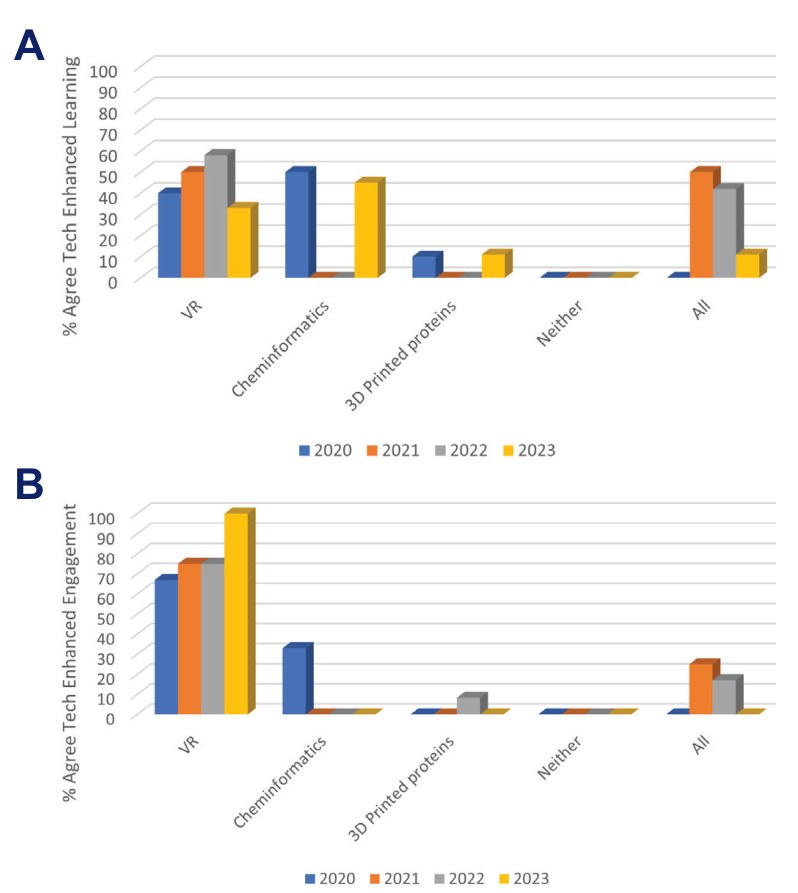
Fig. 2. Student responses to level of agreement with the statement ‘This activity helped the most to A. learn or B. engage with protein–ligand interactions’.
Despite the disruptions associated with COVID-19, the VIBE workshops were delivered throughout the four-year research period. Student feedback consistently supported continued use of 3D technologies in the biochemistry curriculum.
Across the different workshop iterations, 80–100% of participants (n=31) agreed that VR and computer-based 3D modelling improved their understanding of protein–ligand interactions.
An important advantage of these technologies was the ability to examine different molecular characteristics interactively. Students could select representations and investigate particular features of the protein–drug complex according to their learning needs.
Written feedback also indicated that VR and virtual 3D modelling increased engagement. In comparison, the 3D-printed protein models were considered less useful, largely because limitations in print quality reduced the amount of meaningful structural information that could be conveyed.
However, physical models may become more effective if improvements in 3D printing allow colour, texture and other chemically meaningful characteristics to be incorporated.
Tactile models remain valuable because some students prefer hands-on learning experiences. They may also offer important opportunities for students with visual impairments to explore molecular structures through touch (6).
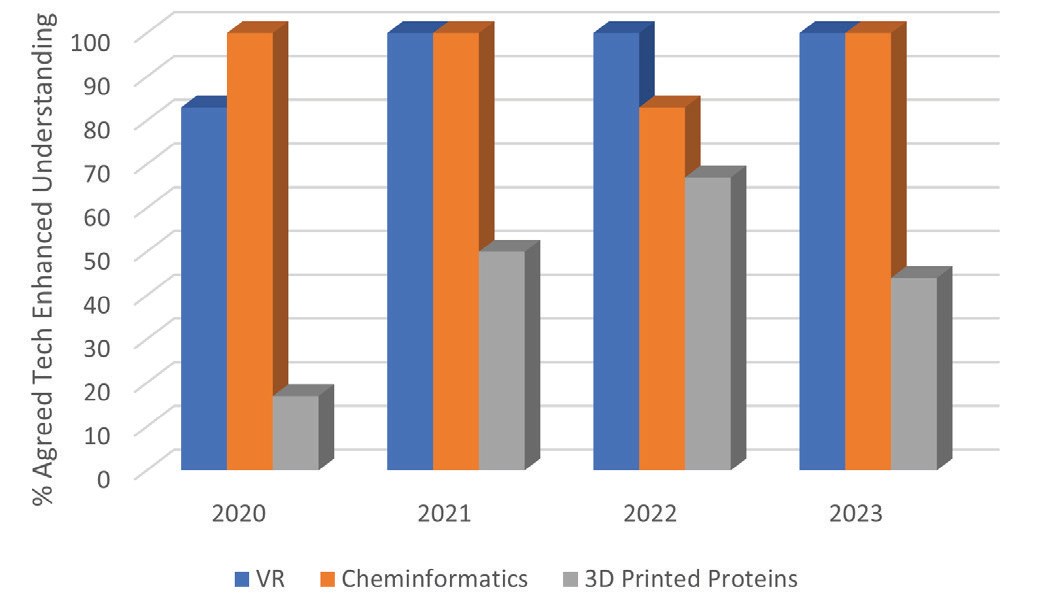
Fig. 3. Student responses when asked the degree to which they agreed that this technology helped them understand how ligands interact with proteins.
Several practical challenges emerged during implementation. These included the cost of purchasing equipment and software, preparation time, timetabling requirements, university Wi-Fi security restrictions and other technical issues.
The workshops were also most effective when delivered to small groups, with sufficient teaching staff available to assist students and ensure they could use the equipment safely and comfortably.
Although these considerations limit the scale of implementation, the positive student feedback suggests that 3D technologies can provide meaningful benefits when incorporated into biochemistry education.
Our findings will help guide future development of technology-supported workshops. We welcome opportunities to collaborate with other educators interested in exploring 3D molecular visualisation and virtual reality in biochemistry teaching.
References
- Linenberger KJ, Bretz SL. Biochem Mol Biol Educ 2015;43(4):213–222.
- Hall S, Grant G, Arora D, Karaksha A, McFarland A, Lohning A, Anoopkumar-Dukie S. Curr Pharm Teach Learn 2017;9(4):723–728.
- Lohning AE, Hall S, Dukie S. J Chem Educ 2019;96(11):2497–2502.
- Ainsworth S, Prain V, Tytler R. Science 2011;333(6046):1096–1097.
- Bennie S, Maritan M, Gast J, Loschen M, Gruffat D, Bartolotta R, Hessenauer S, Leija E, McCloskey S. A Virtual and Mixed Reality Platform for Molecular Design & Drug Discovery – Nanome Version 1.24. 5th Workshop on Molecular Graphics and Visual Analysis of Molecular Data, 2023, The Eurographics Association.
- Oakley A. Australian Biochemist 2023;54(2):19.
About the authors

Dr Anna Elizabeth Lohning is an Associate Professor in the Faculty of Health Sciences & Medicine, Bond University.
alohning@bond.edu.au

Dr Oladayo Folasire is a Senior Teaching Fellow in the Faculty of Health Sciences & Medicine, Bond University.
ofolasir@bond.edu.au

Dr Susan Hall is a Lecturer in the School of Pharmacy and Medical Sciences, Griffith University.
s.hall@griffith.edu.au

Dr Shailandra Dukie is Head of School in the School of Pharmacy and Medical Sciences, Griffith University.
s.dukie@griffith.edu.au

Ryan Wirth is Fabrication Laboratory Manager in the School of Architecture, Bond University.
rwirth@bond.edu.au
This article first appeared in the ASBMB Education Feature of Australian Biochemist Vol 54 No 3, December 2023, pages 23–25.
ASBMB Membership Office
T +61 (03) 9907 8648
E asbmb@wsm.com.au
© 2026 ASBMB. All rights reserved.