Learning by Design: Combining Experiment and Data Generation for Senior Undergraduate Biochemistry Student Research Projects
Jacqueline Matthews and Gareth Denyer
University of Sydney
Our goal was to create an affordable, time-efficient research experience in which senior undergraduate biochemistry students could design experiments, produce their own data and interpret their findings. We achieved this by developing Laboratory Data Generator (LDG) modules to complement established practical laboratory activities.
The Laboratory Data Generator (LDG) is a web-based application developed with the Unity platform. Originally created during the COVID-19 pandemic to address restricted access to teaching laboratories, it allows students to learn through experimentation and the consequences of their decisions.
Instead of providing fixed results, the LDG generates data according to the experimental choices students make and how accurately they perform procedures. The program models relationships between experimental components and produces corresponding outcomes, such as colony numbers following transformation or band patterns in gel electrophoresis.
The associated laboratory practical investigates how mutations in the transcription factor gene GATA1 contribute to human disease. Students use yeast two-hybrid (Y2H) analysis to investigate whether mutations affect interactions between GATA1 and its protein-binding partner FOG. Electrophoretic mobility shift assays (EMSAs) are used to examine changes in GATA1 binding to DNA.
During three laboratory sessions, students develop their understanding of the relevant theory, undertake the experiments and analyse the structural implications of different mutations.
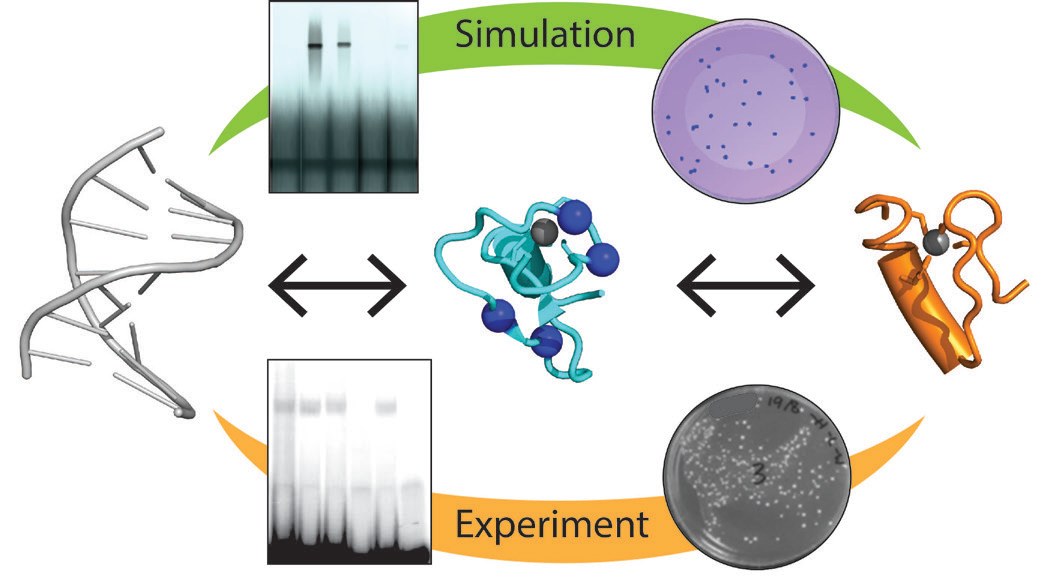
Fig. 1. Overview of data generated through simulation and experiment to investigate the DNA- and protein-binding effects of mutation of a transcription factor.
Students then work in pairs on a research assessment that allows them to investigate a question involving GATA1–FOG or GATA1–DNA interactions. Using the Y2H and EMSA modules, they select from available GATA1 mutants or propose additional mutations, design their experiments, generate data and present their conclusions.
One of the major advantages of this approach is the flexibility to investigate a very large number of mutations. As long as an academic with expertise in protein structure and molecular interactions can predict the likely outcome, a new mutation can be incorporated into the simulation.
A straightforward database interface allows academics without programming experience to add mutants and define their interaction strengths relative to wildtype. This eliminates the need to produce and maintain extensive physical collections of mutant proteins or other experimental materials.
Simulated experiments are also relatively quick. For example, students can complete Y2H and EMSA analyses of four mutants in less than 20 minutes. The web-based system enables convenient access, allowing students to spend more time considering their research design, analysing results and interpreting biological significance.
Student feedback suggests that the preferred sequence is to undertake the physical laboratory experiments first, followed by the LDG research project. This allows students to understand the techniques and develop confidence in data analysis before applying those skills in a more independent investigation.
Many students are already familiar with the LDG from earlier undergraduate courses, making it easier to transition to the new modules.
Student presentations and feedback indicate that generating their own experimental results, rather than working with a predetermined dataset, increases students' sense of ownership of their research. Approximately 20% of student groups requested additional mutations to test hypotheses beyond those supported by the existing database.
From a teaching perspective, the variety of research questions has also made assessment presentations more engaging to mark. Although projects differ in their focus, students are assessed on comparable research activities and expectations.
The LDG contains additional capabilities that students have not yet fully explored, including the estimation of binding affinities through the EMSA module. Some students have independently incorporated other software, including PyMol and Blendr, to model mutations or create visualisations that communicate their findings.
Overall, combining physical laboratory experimentation with virtual data generation has been a successful approach. It brings together established practical teaching and newer digital tools, giving students greater opportunities to develop and investigate their own scientific questions.
About the authors

Professor Jacqui Matthews is Deputy Head of School in the School of Life and Environmental Sciences at the University of Sydney.
jacqueline.matthews@sydney.edu.au

Professor Gareth Denyer is an Educational Designer in the School of Life and Environmental Sciences at the University of Sydney.
gareth.denyer@sydney.edu.au
This article first appeared in the ASBMB Education Feature of Australian Biochemist Vol 55 No 1, April 2024, pages 16–17.
ASBMB Membership Office
T +61 (03) 9907 8648
E asbmb@wsm.com.au
© 2026 ASBMB. All rights reserved.