On the Fly: a Rubric Balancing the Need for Speed and Provision of Feedback – the Oral Presentation
Alyssa Van Dreumel and Peter Arthur
School of Molecular Sciences, University of Western Australia
Developing an effective assessment rubric requires careful planning, clear descriptions of achievement and ongoing refinement. Although rubrics can improve consistency in marking, creating one that is both useful to students and practical for assessors can be challenging (1).
In the second-year undergraduate unit BIOC2001 – Biochemistry and Molecular Biology of the Cell at the University of Western Australia, approximately 100 students undertake laboratory activities each year.
The laboratory program follows a Prepare–Do–Review model (2), with the review stage incorporating a post-laboratory discussion session.
During these sessions, students deliver short oral presentations of up to five minutes, providing opportunities to practise scientific communication, data interpretation and analysis.
Previously, presentations were assessed using a rating scale that identified assessment categories but did not clearly describe the standards associated with different levels of performance.
The absence of detailed performance descriptions created room for differences in interpretation between assessors, potentially contributing to inconsistent marking.
The rating scale also provided limited guidance to students about how to achieve higher marks or improve their performance against specific assessment criteria.
To address these limitations, we redesigned the scoring guide as an analytic, student-centred rubric that could provide meaningful feedback while remaining efficient to use during short presentations.
Developing a Student-centred Assessment Rubric
The redesigned rubric was aligned more closely with the unit's intended learning outcomes and organised around two principal assessment categories.
The first category, presentation skills, focused on students' ability to engage an audience and communicate effectively through their presentation delivery.
The second category, content, considered how effectively students addressed the laboratory question, organised their information, designed visual aids and responded to questions from the audience.
Each category was divided into more specific subcriteria, enabling assessors to evaluate different aspects of performance.
The rubric incorporated four achievement levels, each supported by descriptions intended to distinguish different standards of student work.
By describing what performance looked like at each level, the rubric aimed to make assessment expectations more transparent and provide students with information they could use to improve future work (3).
The redesigned rubric was made available through the university's learning management system so students could review the assessment criteria and understand how their presentations would be evaluated.
In this way, the rubric was intended to serve both as a marking instrument and as a learning resource.
Designing a Rubric for Assessment 'On the Fly'
A major consideration was ensuring that the rubric could be used efficiently while students delivered presentations lasting no more than five minutes.
A detailed rubric may provide useful feedback but can become impractical if assessors must read lengthy descriptions or make complex judgements while simultaneously listening to a presentation.
To balance these requirements, we simplified the rubric's wording, organised criteria into clear categories and avoided descriptions containing too many separate elements.
Performance descriptors were written to make the differences between achievement levels easier to recognise, supporting greater consistency between academic assessors.
We also introduced a tick-box marking system to allow assessors to record their judgements quickly during each presentation.
This approach reduced the time required for marking and helped minimise the additional workload associated with assessing presentations in a time-constrained environment.
Figure 1 illustrates the development from the original rating scale to the more descriptive analytic rubric and the simplified tick-box version used during assessment.
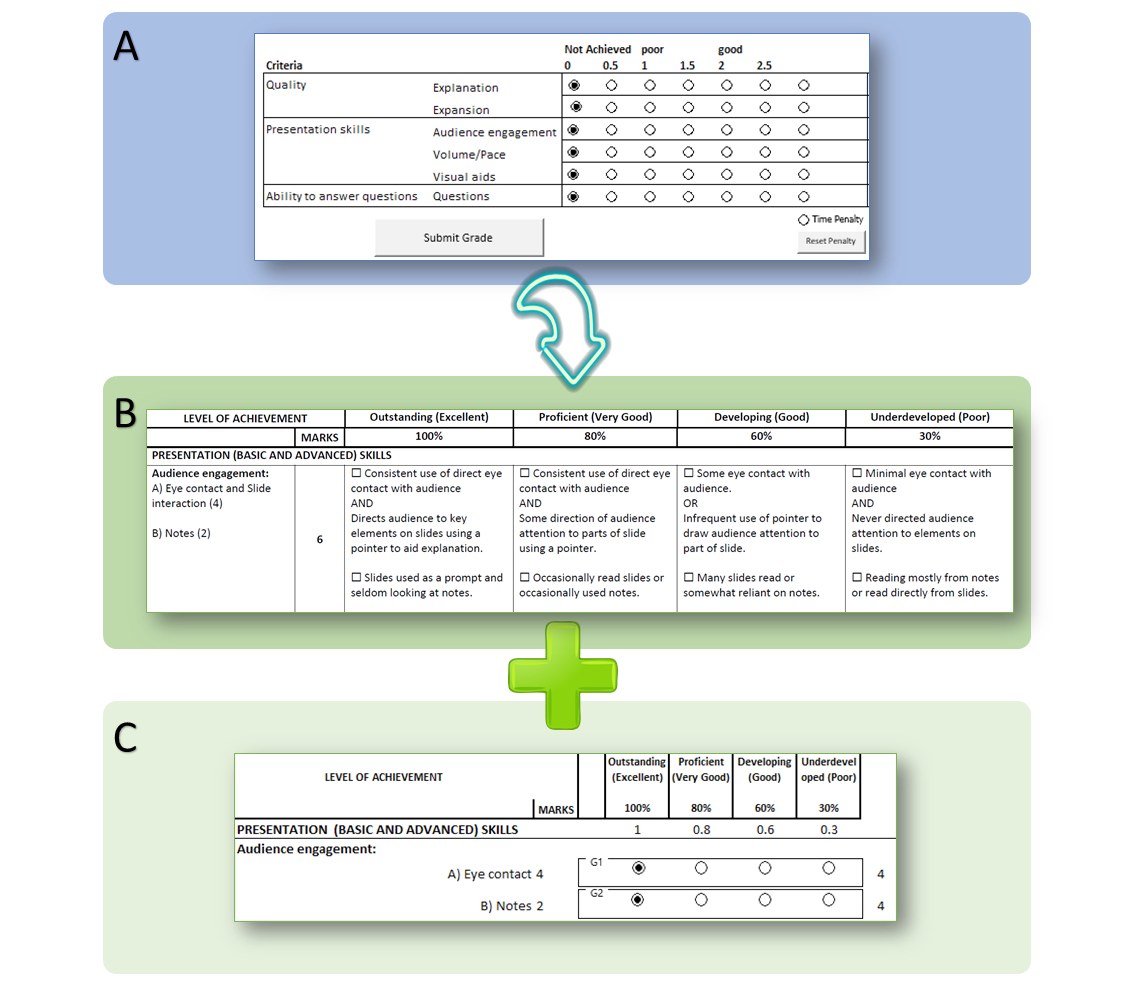
Fig. 1. Reconstruction of a pre-existing scoring guide, a rating scale (A) to an analytic, student-centred rubric (B) with a tick-box version (C) for quick assessment of a time-restrained oral presentation. The rubric is not shown in full.
Evaluating the Redesigned Rubric
To investigate the impact of the revised rubric on assessment outcomes, we compared student marks from two cohorts.
The 2019 cohort of 114 students was assessed using the original rating scale, while the 2021 cohort of 68 students was assessed using the redesigned rubric.
The distribution of marks was compared using the Mann–Whitney U test.
Marks awarded in 2021 were less skewed, more symmetrical and showed a wider distribution than those awarded in 2019.
However, the difference in median marks between the two cohorts was not statistically significant.
Results from 2020 were excluded because the COVID-19 pandemic required modifications to the delivery and assessment of oral presentations, which were conducted online.
The redesigned rubric also appeared to improve consistency between assessors.
The standard deviation of marks awarded in 2021 was lower than in 2019, providing an indication of greater agreement in assessment outcomes.
Together, these findings suggested that the redesigned rubric could support more consistent marking without substantially changing the overall level of student achievement.
Reflections and Further Improvements
Once assessors became familiar with the criteria and performance descriptions, the redesigned rubric proved practical to use during short oral presentations.
The simplified marking format allowed academic staff to assess students efficiently while still recording performance against defined criteria.
Reflections from the teaching team indicated that most students performed well on the assessment task.
Nevertheless, the rubric continues to be refined in response to assessor experiences and the ongoing need to improve the clarity and usefulness of assessment criteria (4).
Minor differences in the interpretation of certain performance descriptions remained evident between assessors.
To address these issues, some descriptors were reworded to make their meaning clearer and reduce the potential for inconsistent interpretation.
Another area identified for improvement was student engagement with the rubric itself.
Although the rubric was available through the learning management system, it was not clear whether students in the 2021 cohort had actively consulted it before their presentations or used the feedback afterwards.
Simply providing students with a rubric does not necessarily ensure that they will use it to guide their learning.
In future iterations, the revised rubric will be formally introduced to students, together with guidance on interpreting assessment criteria and using feedback constructively.
Providing feedback promptly and explaining how it can be applied to subsequent assessment tasks will help strengthen the rubric's value as a learning tool (3).
The experience demonstrates that a well-designed rubric can balance the need for efficient assessment with the provision of meaningful feedback.
By using concise performance descriptions, clear achievement levels and a practical tick-box format, educators can support consistent marking while helping students understand the standards expected in scientific oral presentations.
The authors welcome feedback on the approach and can be contacted to request a copy of the full rubric.
References
- Ragupathi K, Lee A. Beyond Fairness and Consistency in Grading: the Role of Rubrics in Higher Education. In: Sanger C, Gleason N (eds), (2020) Diversity and Inclusion in Global Higher Education. Palgrave Macmillan. pp 73–95.
- Arthur P, Ludwig M, Castelli J, Kirkwood P, Attwood P (2016). Biochem Mol Biol Educ 44(3):276–287.
- Jonsson A (2012). Act Learn High Educ 14(1):63–76.
- Jonsson A, Svingby G (2007). Educ Res Rev 2(2):130–144.
About the authors

Dr Alyssa Van Dreumel is a Teaching Academic in the School of Molecular Sciences at the University of Western Australia.
alyssa.vandreumel@uwa.edu.au

Dr Peter Arthur is a Teaching and Research Academic in the School of Molecular Sciences at the University of Western Australia.
peter.arthur@uwa.edu.au
This article first appeared in the ASBMB Education Feature of Australian Biochemist Vol 53 No 1, April 2022, pages 16–17.
ASBMB Membership Office
T +61 (03) 9907 8648
E asbmb@wsm.com.au
© 2026 ASBMB. All rights reserved.