Open-book and Open-AI Mindset: Strategies to Redesign Final Exams in Response to Generative AI and the Potential for Academic Misconduct
Eduardo Araujo Oliveira and Sarah Frankland
University of Melbourne
The COVID-19 pandemic required universities to move many final examinations from supervised, in-person settings to online delivery. This change increased opportunities for academic misconduct, as students completing examinations remotely could access search engines, websites and other digital resources to obtain answers (1,2).
The emergence of ChatGPT in 2022 introduced further challenges for assessment integrity. Generative artificial intelligence (AI) tools demonstrated an ability to produce coherent, original-looking responses to straightforward questions, raising concerns about students submitting AI-generated work as their own (3).
In this article, we describe how a final examination worth 60% of a subject's overall grade was redesigned to reduce opportunities for misconduct while improving the assessment of students' understanding and ability to apply their knowledge.
Redesign of Software Design and Architecture final exam
Software Design and Architecture is a compulsory subject in the Master of Software Engineering at the University of Melbourne, typically enrolling between 80 and 100 students.
Between 2012 and 2019, the subject concluded with a two-hour, supervised written examination worth 60% of the final grade (4). Questions largely assessed students' knowledge of definitions, established principles and theoretical concepts.
Although these questions tested foundational knowledge, they offered limited opportunities for students to demonstrate how they could apply their understanding to authentic professional problems (5).
The transition to online, open-book examinations during the pandemic provided an opportunity to reconsider this approach. The teaching team sought to develop an assessment that would encourage higher-order thinking while making it more difficult for students to obtain satisfactory answers simply by searching online or using generative AI.
The redesigned examination therefore emphasised analysis, evaluation, synthesis and the application of software engineering concepts to unfamiliar situations.
Instead of asking students to reproduce established definitions or describe familiar principles, questions presented unique scenarios involving realistic or hypothetical organisations and required students to propose and justify solutions.
These scenarios were constructed specifically for the examination, meaning that complete answers could not readily be located through internet searches or reproduced from commonly available examples.
To prepare students for the revised format, a practice examination was delivered through Gradescope during Week 11. This familiarised students with both the assessment platform and the style of questions they would encounter.
The examination was also closely aligned with the subject's project-based learning activities, which contributed the remaining 40% of the final grade.
Students completed four project deliverables between Weeks 1 and 11, receiving feedback throughout the semester. The final examination then required them to apply similar reasoning and problem-solving skills to new situations.
Table 1 illustrates the difference between the original and redesigned examination formats using an example concerning software performance.
Table 1. Comparison of original and redesigned examination questions
Example of a question about software performance in the original and new final exam.
| Assessment format | Question and assessment approach |
|---|---|
|
Original examination Focus: memorisation ChatGPT score: 8.5/10 |
Students were given an explanation of Content Delivery Networks (CDNs) and their use in storing cached data closer to users. They were asked to identify two characteristics that make data suitable for caching and explain how poorly designed caching algorithms can adversely affect system performance. Assessment approach: The question explicitly identified the relevant software engineering concepts and required students to describe established knowledge that could be found in textbooks or online resources. |
|
Redesigned examination Focus: scenario analysis and application |
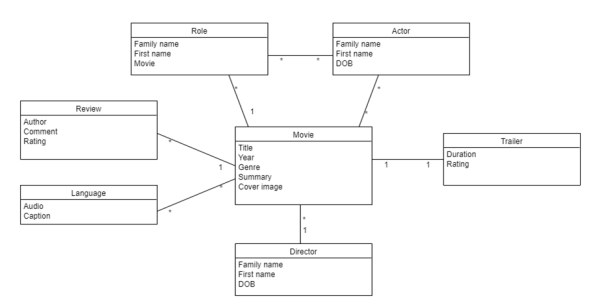
Students were presented with a hypothetical online movie streaming company called Flix. The company had attracted 100,000 users during its first month, and its subscriber base was continuing to grow. Customers could browse a large movie catalogue, but performance problems were affecting the user experience. Students were provided with the following domain model diagram.
Domain model diagram of Flix. The scenario identified several performance issues:
Students were also informed that viewing preferences were influenced by movie popularity within a subscriber's geographical area and preferred language. |
|
Redesigned examination question Focus: analysis, evaluation and application ChatGPT score: 2/10 |
Students were required to select four relevant software design principles or patterns covered in the subject that could improve Flix's performance. For each proposed solution, they needed to justify how the selected principle or pattern would address the company's specific problems, using diagrams where appropriate. Assessment approach: Rather than naming the relevant concepts, the question required students to determine which principles were appropriate, explain their reasoning and apply their knowledge to a new situation. |
The comparison demonstrated an important difference in how generative AI responded to the two assessment formats.
ChatGPT achieved a score of 8.5 out of 10 on the original question, which tested knowledge of established concepts. In contrast, it achieved only 2 out of 10 on the redesigned scenario-based question.
The teaching team concluded that the revised format made it more difficult for students to generate high-scoring answers using generative AI or readily available online information.
Developing questions that require application and higher-order reasoning involves additional preparation time. However, this investment provides benefits beyond academic integrity.
The redesigned examination enabled a more meaningful evaluation of students' ability to interpret complex situations, identify relevant principles and justify professional decisions.
Importantly, the change did not result in a significant difference in overall student performance compared with previous years. Grade distributions remained similar despite the revised assessment format.
Foundational knowledge remains essential in all academic disciplines. Students must still learn and remember important principles, definitions and facts.
Nevertheless, high-stakes examinations can provide greater educational value when they assess how students use that knowledge to analyse, evaluate and solve unfamiliar problems.
Although this example comes from software engineering, the underlying principles can be adapted to biochemistry and molecular biology education and other disciplines.
Designing authentic assessments that encourage application, synthesis and critical thinking offers one approach to strengthening academic integrity while supporting deeper student learning.
References
- Dawson P, Sutherland-Smith W, Ricksen M. Assess Eval High Educ 2020;45(4):473–482.
- Foltýnek T, Meuschke N, Gipp B. ACM Comput Surv 2019;52(6):1–42.
- Kasneci E, Seßler K, Küchemann S, et al. Learn Individ Differ 2023;103:102274.
- Oliveira EA, Valentine A. Redesigning software architecture and design curriculum to promote professional skills among software engineering students: an experience report. Proceedings of the Australasian Association for Engineering Education Conference, 2022. Western Sydney University, NSW.
- Koh KH. Authentic assessment. In: Oxford Research Encyclopedia of Education. Oxford University Press, 2017.
About the authors

Dr Eduardo Oliveira is a Senior Lecturer in the School of Computing and Information Systems at the University of Melbourne.
eduardo.oliveira@unimelb.edu.au

Dr Sarah Frankland is an Associate Professor in the School of Agriculture, Food and Ecosystem Sciences at the University of Melbourne.
sarah.frankland@unimelb.edu.au
This article first appeared in the ASBMB Education Feature of Australian Biochemist Vol 54 No 2, August 2023, pages 20–21.
ASBMB Membership Office
T +61 (03) 9907 8648
E asbmb@wsm.com.au
© 2026 ASBMB. All rights reserved.