Premeditated Blunders to Trigger Cognitive Learning in Biochemistry: Perceptions of Undergraduate and Postgraduate Students Pursuing Medical Sciences
Sheethal Mohan¹, Chandrika Nayak² and Ullas Kamath²
¹Department of Anatomy and Physiology, University of Melbourne
²Department of Basic Medical Sciences, Manipal Academy of Higher Education, Manipal, India
Encouraging students to participate actively in lectures is an important goal of effective teaching. One approach involves deliberately introducing information that conflicts with what students believe they know. This creates cognitive conflict, prompting students to question, reconsider and strengthen their understanding.
A teaching technique known as blunder lectures (BL) uses this principle by having lecturers intentionally present incorrect information. Previous studies have explored the approach in physiology and anatomy education, including tutorials for undergraduate medical students.
Professor Ullas Kamath has used deliberate mistakes in biochemistry teaching for approximately three decades. Examples include incorrectly describing glucagon as a storage polysaccharide, insulin as a steroid hormone, or pyruvate as being converted to lactose under aerobic conditions.
These mistakes focus on fundamental concepts and are subsequently explained and corrected during the lecture. Figure 1 provides an example involving an incorrect biochemical pathway.
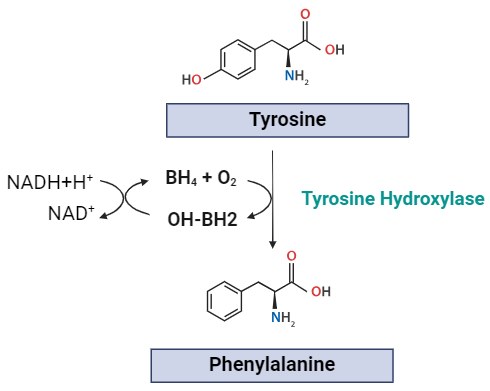
Fig. 1. Synthesis of phenylalanine from tyrosine in humans. Created in BioRender.
The researchers investigated how undergraduate and postgraduate medical sciences students perceived blunder lectures. Participants included first-year undergraduate medical students at Melaka Manipal Medical College and first-year postgraduate Master of Medical Sciences students at Kasturba Medical College in Manipal, India.
Both groups experienced at least ten hours of teaching using deliberate mistakes. Following their first year of study, students completed a questionnaire examining three aspects of the experience: their immediate response to the mistakes, their engagement during lectures and their learning after lectures. The study received institutional ethics approval.
The first domain investigated whether students recognised the mistakes, challenged the lecturer and reconsidered the assumption that lecturers are always correct. Undergraduate students were more likely to report uncertainty about identifying mistakes, but were also more inclined to question them.
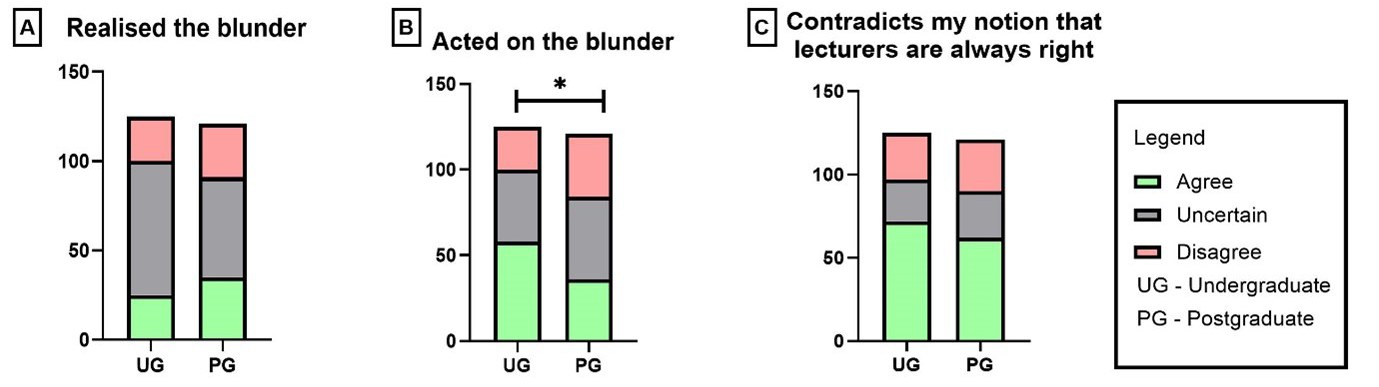
Fig. 2. Domain 1: Student perceptions of BL as a learning experience. Questionnaire data analysed using a chi-square test (UG n=125, PG n=123). Undergraduate students reported greater uncertainty about recognising mistakes (60.0% versus 46.3%), but were more likely to act on them (46.4% versus 29.7%; p<0.05). More than half of both groups agreed that the experience challenged their assumption that lecturers are always right.
The second domain examined students' perceptions of their learning during lectures. Both undergraduate and postgraduate students overwhelmingly agreed that deliberate mistakes encouraged active engagement. Agreement was also strong regarding the stimulation of thinking, particularly among postgraduate students.
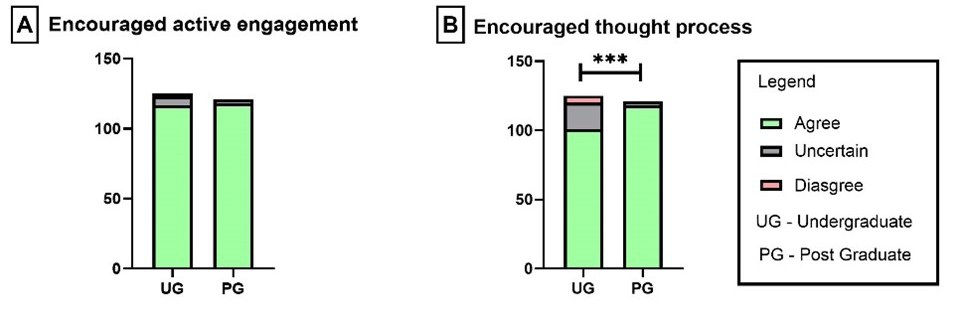
Fig. 3. Domain 2: Perceptions of BL on learning during lectures. Questionnaire data analysed using a chi-square test (UG n=125, PG n=123). Active engagement was supported by 93% of undergraduate and 97.5% of postgraduate students. The strategy encouraged thought processes among 80% of undergraduate and 97.5% of postgraduate students (p<0.001).
The third domain considered learning after the lecture, including reinforcement of fundamental concepts, recall of facts and motivation to consult reference materials. Postgraduate students reported stronger benefits across these measures, suggesting that prior knowledge and experience may influence the effectiveness of this teaching strategy.
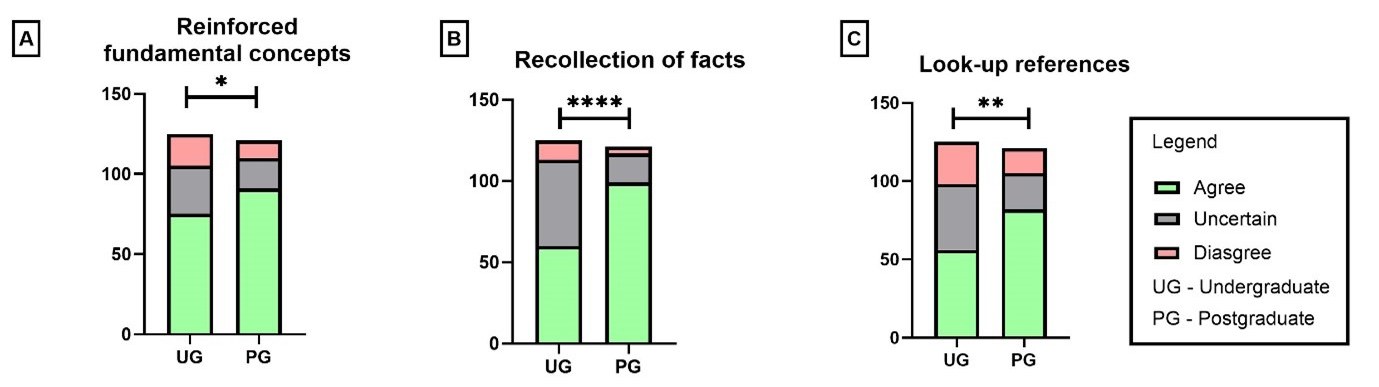
Fig. 4. Domain 3: Perceptions of BL on learning after lectures. Questionnaire data analysed using a chi-square test (UG n=125, PG n=123). Postgraduate students reported greater reinforcement of fundamental concepts (75.2% versus 60.0%), recollection of facts (81.8% versus 48.0%) and motivation to consult references (67.77% versus 44.8%).
Overall, the findings suggest that blunder lectures can promote active participation and critical thinking in biochemistry education. Undergraduate students may be more inclined to question a lecturer when they notice an inconsistency, whereas postgraduate students may draw more effectively on their existing knowledge to recognise mistakes and consolidate their learning.
The authors also note that two members of the research team previously experienced this teaching method as postgraduate students and subsequently incorporated elements of the approach into their own teaching.
Deliberate mistakes may have applications beyond lectures, including formative assessment activities designed to develop metacognitive skills. The technique could also help sustain student engagement as recorded lectures become increasingly common.
Were you able to spot the blunder in Figure 1?
References
- Sing S. Adv Physiol Educ 2014;38(3):265–267.
- Nayak BS, Somayyaji NS, Komattil R. Adv Physiol Educ 2005;29(2):130–131.
- Chauhan A, Mahajan N, Christian DS, Trigotra S. Natl J Physiol Pharm Pharmacol 2022;12(10):1702–1708.
About the authors

Sheethal Mohan is a Senior Tutor in the Department of Anatomy and Physiology, University of Melbourne.
sheethal.mohan@unimelb.edu.au

Dr Chandrika Nayak is a Professor of Biochemistry in the Department of Basic Medical Sciences, Manipal Academy of Higher Education, Manipal, India.
chandrika.nayak@manipal.edu

Dr Ullas Kamath is Dean of Melaka Manipal Medical College and Head of the Department of Basic Medical Sciences, Manipal Academy of Higher Education, Manipal, India.
ullas.kamath@manipal.edu
This article first appeared in the ASBMB Education Feature of Australian Biochemist Vol 55 No 2, August 2024, pages 18–20.
ASBMB Membership Office
T +61 (03) 9907 8648
E asbmb@wsm.com.au
© 2026 ASBMB. All rights reserved.