Science Fiction Prototyping: Making the Impossible, Possible
Julian Pakay¹ and Evie Kendal²
¹Department of Biochemistry and Chemistry, La Trobe University
²Swinburne University of Technology
There is an undeniable link between science and science fiction. Writers of speculative fiction are often inspired by real-world science and technology and in turn scientists, although constrained by physical laws, often derive inspiration from fiction. There is a similarity to how both work in conducting gedanken (thought) experiments to test the logic and consequences of a hypothetical scenario (1).
Science fiction prototyping is a methodology introduced to help formalise the link between speculative fiction and science and promote innovation by extrapolating trends from research.
Science fiction narratives can further stimulate the moral imagination such that the social and ethical implications of novel technologies on individuals and society can be evaluated.
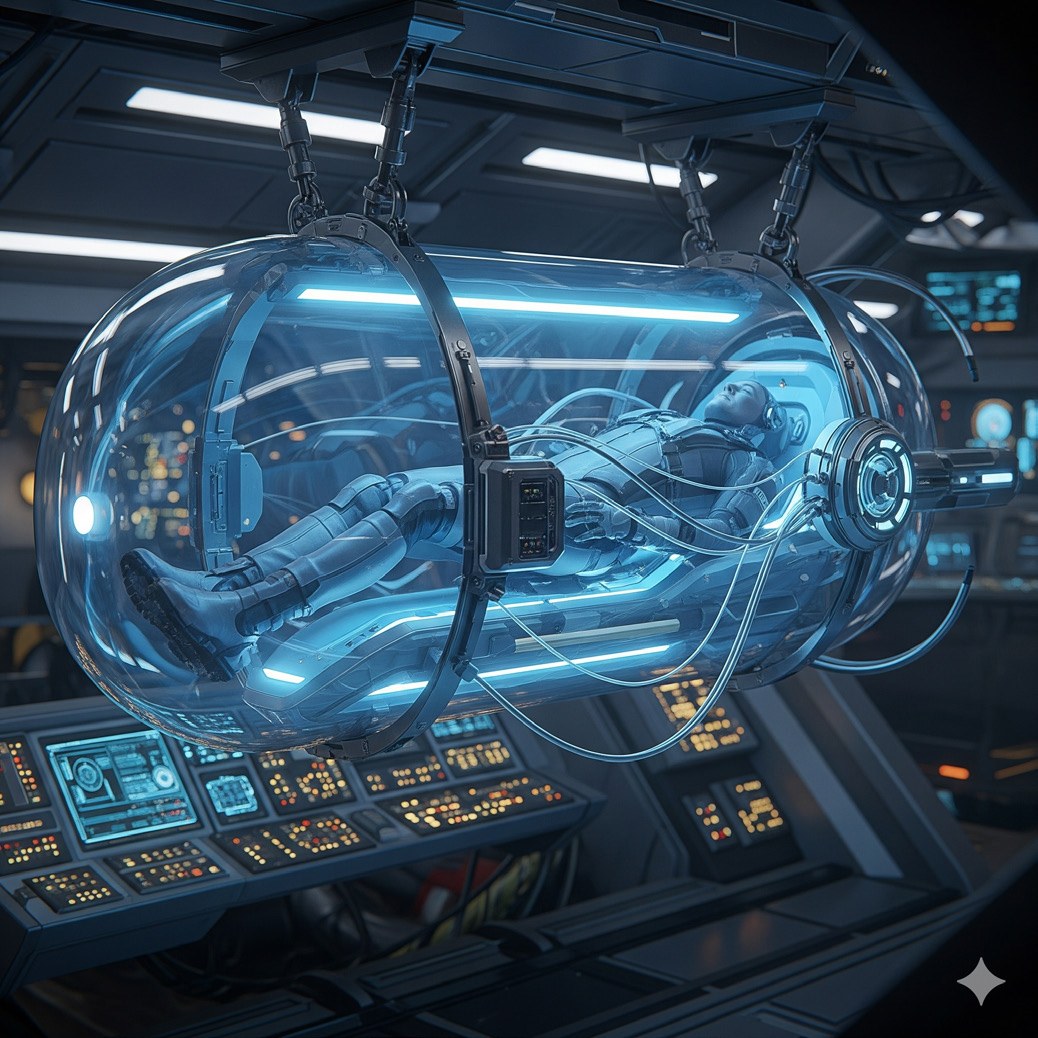
Fig. 1. Putting humans in suspended animation to survive for extended periods of time on long space voyages is a common trope in science fiction. Although metabolic depression occurs naturally in diverse phyla, it represents a challenge to replicate it in humans. Image generated by Google Gemini, 2025.
As part of our major in biochemistry at La Trobe University, we use science fiction prototyping to engage students, guide their exploration of cutting-edge research, provoke greater consideration for the societal and ethical consequences of research and foster creative thinking. Students begin by identifying a biotechnology or biological phenomenon in a work of science or speculative fiction (book, story, film or computer game).
The one major caveat is that the idea must relate to biochemistry, molecular and/or cellular biology. So, although students start with a fictional prompt, they must extensively use the primary literature to investigate the scientific background and feasibility of the idea.
Depending on the inspiring fiction, we encourage students to ask:
- Is this an active area of research?
- Are there any real-world precedents for this innovation?
- If a biological system requires modification (e.g. through gene editing) for this innovation to be realised, describe how the base system works.
- What would we need to solve or discover first to make this innovation possible?
For example, the common science fiction trope of suspended animation to survive long space voyages has a real-world precedent in metabolic depression commonly seen in nature. Many organisms survive for extended periods by entering a state of estivation, hibernation or anhydrobiosis. In fact, and although we might be far from suspended animation for long space voyages, understanding metabolic depression in comparative systems has practical applications in trauma medicine and organ transplants (2) (Fig. 1).
In our experience, most ideas similarly provide agency to students to explore different aspects and implications.
Even with seemingly far-fetched premises, it is possible to make links to real science (see Table 1).
For our unit, students present their science fiction prototype as a 15-minute seminar to examiners and their peers, pitched at the level of the informed, non-specialist. They are instructed to use the fictional prompt sparingly to engage audience attention before going into the scientific content, which should form the bulk of their presentation. They are then expected to conclude with speculation of the ethical and/or societal impact of their prototype.
In assessing the task, we emphasise the clarity of presentation, engagement with the primary literature, demonstration of understanding and depth of reading in answering questions and if their thought experiment has yielded logical consequential conclusions.
The level of student agency with this assignment necessitates guidance. To this end, students pitch their ideas in the form of a 1000/24/7 lecture (a seven-word title, a 24 second pitch, accompanied by one image) (3). This early intervention pedagogical strategy allows ideas to be vetted for suitability to the task, helping students identify relevant primary sources and importantly a mechanism for students with similar topics to share.
We also incorporate a formal drafting and peer review session before their final presentation. Students also benefit from guest seminars on novel research and ethics. This year, we have had guest lectures from researchers working in deep learning and AI, space biology and speculative bioethics. We have also previously attempted this assessment as a group project, however, the choice of inspiring fiction seems to be highly personal.
Based on our experience, we would advise that groups are given a topic or are grouped only following an individual pitch.
Although students find this assignment difficult, feedback suggests that they also find it engaging and that it inspires curiosity: “This assignment not only reinforced what I've learned but also inspired a curiosity to understand how these concepts can drive future advancements. Exploring potential emerging technologies through our current understanding of biochemistry was truly motivating.” “I was the kid who spent a lot of time reading comics while fantasising about being a superhero. And although that is possibly still centuries away, I have learned how gene editing technologies may truly achieve that.” “I found it enjoyable to research through the prism of science fiction and relate it to current scientific understandings. Overall, it was a great assignment.”
Table 1. Previous science fiction prototyping student projects.
| Inspiring Fiction | Technology | Real-world Science |
|---|---|---|
| Green Mars (1993) novel by Kim Stanley Robinson | Terra-forming Mars | Genetic engineering for enhanced biological nitrogen fixation in cereal crops |
| Star Wars Universe | Bacta-tank – accelerated healing | Promoting tissue regeneration by immune system modulation |
| Reanimator (1922) novella by HP Lovecraft | Reanimating the recently dead | Comparative approaches to understand the limited regenerative capacity of mature human neurons. |
| Epic of Gilgamesh (c2100–1200 BCE) poem from ancient Mesopotamia | Lifespan extension | Therapies for eliminating senescent cells |
| Altered Carbon (2002) novel by Richard Morgan | Mind uploading | Neural mapping and the human connectome |
| The Pod Generation (2023) film by Sophie Barthes | Artificial wombs – ectogenesis | Understanding the role of maternal–foetal interactions in foetal immune system development |
This assessment replaced a previous task where students investigated an emerging biotechnology, with most choosing recent iterations on established technologies, such as gene editing. Since most undergraduate work is confirmatory, we prefer this assessment which forces students to think critically and consider the hypothetical. In this way, we increase engagement and importantly also reduce issues with academic integrity and the misuse of generative AI (4).
This assessment also serves to provide a better understanding of how research functions in society where, like in science fiction, it works to make the impossible, possible!
References
- Rahwan I, Shariff A, Bonnefon J-F. Nature 2025;644(8075):51–58.
- Shi Z, Qin M, Huang L, Xu T, Chen Y, Hu Q, Peng S, Peng Z, Qu LN, Chen SG, Tuo QH, Liao DF, Wang XP, Wu RR, Yuan TF, Li YH, Liu XM. Biol Rev Camb Philos Soc 2021;96(2):642–672.
- Cossette J. 1000/24/7 Lectures. Passionately Curious. 2018. View article.
- Lye CY, Lim L. Educ Sci 2024;14(6):569.
About the authors
Julian Pakay is an Education-Focused Senior Lecturer in the Department of Biochemistry and Chemistry, La Trobe University.
j.pakay@latrobe.edu.au

Evie Kendal is a Senior Lecturer of Health Promotion in the Department of Biomedical, Health and Exercise Sciences, Swinburne University of Technology.
ekendal@swin.edu.au
This article first appeared in the ASBMB Education Feature of Australian Biochemist Vol 57 No 1, April 2026, pages 15–17.
ASBMB Membership Office
T +61 (03) 9907 8648
E asbmb@wsm.com.au
© 2026 ASBMB. All rights reserved.