Student and Staff Perspectives on Online Proctored and Open-book Exams
Matthew Clemson and Alice Huang
School of Life and Environmental Sciences, University of Sydney
The widespread introduction of online examinations during the COVID-19 pandemic significantly changed the assessment experience for both university students and academic staff.
With traditional face-to-face examination supervision unavailable, universities were required to reconsider how final examinations could be delivered remotely while maintaining academic integrity and providing meaningful assessment of student learning.
The rapid transition to remote learning in 2020 meant that many examinations were initially conducted online without invigilation.
This approach encouraged course coordinators to reconsider the types of questions included in examinations.
Questions that relied primarily on recalling information became less effective when students could readily search for answers online.
Instead, educators were encouraged to design assessments that targeted higher levels of Bloom's taxonomy, requiring students to apply their knowledge, interpret unfamiliar data and develop conclusions supported by logical reasoning.
In some respects, this shift created opportunities for more authentic assessment because students were required to demonstrate their understanding rather than simply reproduce memorised information.
Managing Academic Integrity in Online Examinations
During the initial transition to online examinations, academic integrity was managed through a combination of assessment design and technological safeguards.
These measures included limiting the weighting and duration of examinations, randomising questions and answer options, developing question banks and presenting examination questions individually rather than displaying the entire paper at once.
Text-matching software was also used to identify similarities between students' written responses.
Although these strategies helped reduce opportunities for academic misconduct, preparing new open-book examinations each semester created a substantial workload for academic staff.
Developing suitable questions, maintaining question banks and reviewing assessment security required considerable time and effort.
Despite these measures, concerns about academic integrity remained, particularly where examinations were completed remotely without direct supervision.
In 2021, the University of Sydney introduced remotely invigilated examinations more widely across its Faculty of Science.
Approximately two-thirds of all examinations in the Faculty of Science were conducted using ProctorU Review+, an online proctoring system that uses artificial intelligence to identify potential academic integrity concerns during examinations.
The software records examination activity and identifies events that may require further investigation.
Potential breaches are subsequently reviewed through a central process, with additional action taken where necessary.
Implementing ProctorU Review+ in Biochemistry and Molecular Biology
In our large second-year Biochemistry and Molecular Biology course, enrolling approximately 800 students, we used ProctorU Review+ to deliver examinations in two different formats.
The mid-semester examination was conducted as a closed-book test.
The final examination was delivered as an open-book, closed-web assessment, allowing students to consult permitted materials while restricting access to online resources.
For course coordinators, the proctoring system provided greater confidence that the registered students were completing their own examinations and that the assessment conditions were being followed.
It also helped provide assurance that students were working independently and accessing only the resources permitted for each examination.
An additional benefit was the protection offered against examination questions being copied and distributed online.
However, the introduction of artificial intelligence-based monitoring created a new set of challenges for students, many of whom were unfamiliar with this type of examination supervision.
Student Concerns and Experiences
To understand students' experiences with online proctored examinations, we examined 98 emails and online discussion posts relating to the assessment process.
These communications provided insight into the practical difficulties students encountered and the concerns they raised before and during their examinations.
The largest category of enquiries involved technical issues, with 51 posts concerning the installation or operation of ProctorU and its compatibility with students' computers, webcams and microphones.
Students also frequently sought clarification about examination rules and which resources they were permitted to use.
There were 18 enquiries relating to permitted materials, reflecting uncertainty about the requirements of online examinations.
A further 19 enquiries involved concerns about incidents that students feared might be interpreted as cheating.
Examples included needing to use the bathroom, mobile phones ringing, unexpected email notifications or pop-up messages, and family members or other people speaking or entering the room during an examination.
These concerns demonstrated that students remained very conscious of being monitored, even though no human invigilator was directly supervising the examination.
Interestingly, only two students explicitly raised concerns about privacy in the recorded communications.
Nevertheless, it is possible that additional students had privacy concerns but chose not to communicate them directly to the teaching team.
Figure 1 summarises the categories of student enquiries associated with the online proctored examinations.
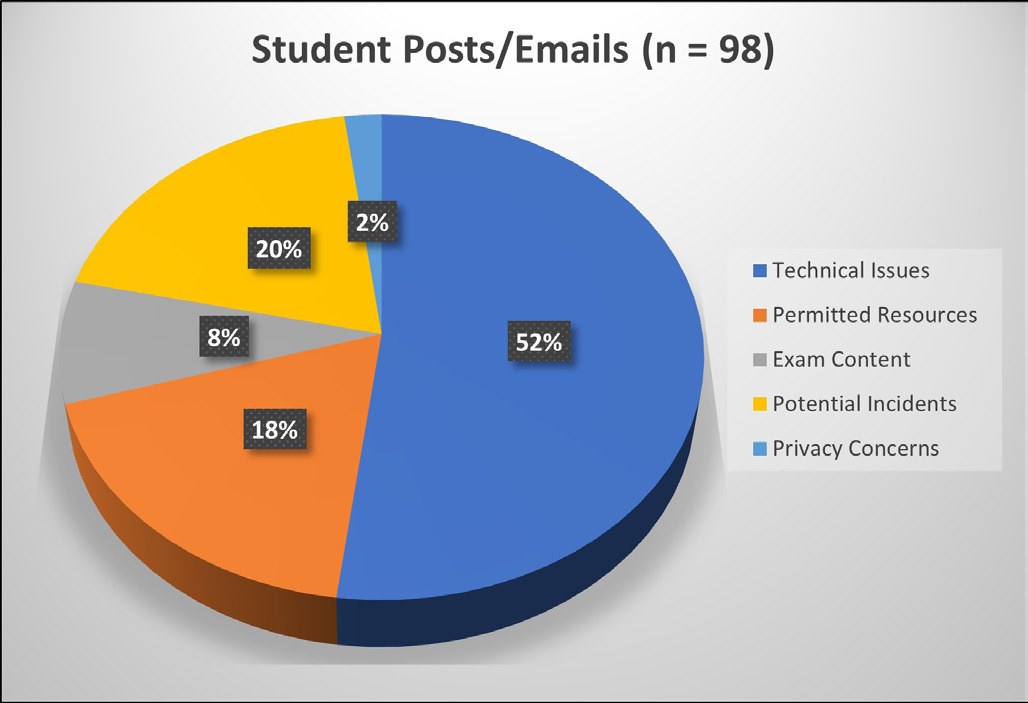
Fig. 1. Summary of student queries about online proctored exams.
Comparing AI and Human Invigilation
Some students had previously completed examinations using ProctorU Live+, which involves supervision by a human invigilator.
Anecdotal feedback from these students suggested that they strongly preferred the artificial intelligence-based Review+ system.
Students also expressed a preference for open-book examinations, which allowed them to consult permitted learning materials during the assessment.
The number of student enquiries and concerns decreased considerably during the second examination.
This reduction appeared to reflect students becoming more familiar with the examination software, technical requirements and assessment procedures.
The experience highlighted the importance of providing clear instructions and allowing students sufficient opportunities to become comfortable with unfamiliar examination technologies.
Academic Integrity Outcomes and Staff Workload
Despite some technical difficulties, the majority of online examinations were completed successfully.
Across the Biochemistry and Molecular Biology course, approximately 1,600 examinations were conducted using the online assessment arrangements.
Of these, only two recorded incidents of academic integrity breaches were identified.
This represented a relatively small number of recorded breaches in a large examination cohort.
However, the successful delivery of these examinations depended on substantial work by academic and professional staff.
Considerable preparation was required to establish examination conditions, configure the proctoring system, communicate requirements to students and respond to technical and administrative enquiries.
Staff also needed to review examination arrangements and support students who encountered difficulties before or during their assessments.
Although online proctoring provided benefits in managing examination security, it did not eliminate the workload associated with preparing and delivering large-scale assessments.
Our experience therefore illustrates the importance of considering both the advantages and limitations of online proctored examinations.
As we planned assessment arrangements for 2022, we continued to evaluate the practical challenges, academic integrity outcomes and student experiences associated with online examinations.
The broader experience of remote assessment during the pandemic has provided valuable opportunities to reconsider examination design, the use of digital monitoring technologies and the balance between academic integrity, student experience and staff workload.
About the authors

Dr Matthew Clemson is a Lecturer in Biochemistry, Cellular and Molecular Biology in the School of Life and Environmental Sciences (SOLES) at the University of Sydney.
matthew.clemson@sydney.edu.au

Dr Alice Huang is a Lecturer in Biochemistry, Cellular and Molecular Biology in the School of Life and Environmental Sciences (SOLES) at the University of Sydney.
alice.huang@sydney.edu.au
This article first appeared in the ASBMB Education Feature of Australian Biochemist Vol 53 No 1, April 2022, pages 17–18.
ASBMB Membership Office
T +61 (03) 9907 8648
E asbmb@wsm.com.au
© 2026 ASBMB. All rights reserved.