Student Partners: Strengthening Staff–Student Connections Beyond the Pandemic
Anne Galea, Kristin Turnbull and Collins Fleischner
University of New South Wales
Creating opportunities for students to collaborate with academic staff in the design, implementation and evaluation of educational initiatives can improve learning experiences for both students and educators (1).
When students are encouraged to contribute actively to the development of their courses, they become more than recipients of educational content. They can participate as partners in shaping their learning environment.
Student–staff partnerships recognise the valuable perspectives, experiences and capabilities students bring to higher education. By involving students in educational decision-making, universities can create opportunities for students to act as agents of change within their learning communities.
In this article, we describe an approach to embedding student–staff partnerships within undergraduate biochemistry and molecular biology courses at the University of New South Wales (UNSW), and how this initiative contributed to the development of a broader university-wide program.
Student Course Ambassadors
During the COVID-19 pandemic, large second-year biochemistry and molecular biology courses at UNSW introduced a Student Course Ambassador Program to strengthen communication, collaboration and engagement between students and teaching staff.
At the beginning of each teaching term, students were invited to nominate themselves for the ambassador role.
Student Course Ambassadors participated in regular meetings and communications with academic staff, providing feedback on different aspects of course content, assessment and delivery.
This approach created an ongoing communication channel through which students could identify successful teaching practices, highlight difficulties and suggest improvements while courses were still being delivered.
Importantly, the program allowed educators to respond to feedback during the teaching term rather than relying exclusively on evaluations collected after the course had finished.
To acknowledge their contributions and service, Student Course Ambassadors received a digital certificate upon completing their role.
Although the program was initially established to facilitate timely feedback and improvements, its purpose soon expanded.
Students were increasingly encouraged to contribute creative ideas, participate in strategic discussions and help develop educational resources.
The ambassador role also provided opportunities for students to develop leadership, communication and professional skills while making meaningful contributions to their courses.
Examples of the activities undertaken by Student Course Ambassadors are presented in Figure 1.
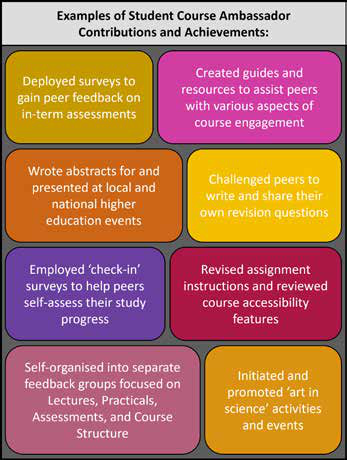
Fig. 1. Examples of Student Course Ambassador Contributions and Achievements.
Ambassador contributions included gathering feedback from peers about assessments, developing guides and resources to assist students, and sharing revision questions.
Students also prepared abstracts and presented their experiences at local and national higher education events.
Other activities included developing informal study progress check-ins, reviewing assessment instructions and course accessibility, and establishing separate feedback groups focused on lectures, practical classes, assessments and course structure.
Some ambassadors also initiated and promoted art-in-science activities and events, helping to strengthen engagement beyond traditional coursework.
The Student Course Ambassador Program received consistently positive feedback and was associated with high levels of course satisfaction.
Its success also helped inform the development of a broader Student Partner Program at UNSW, designed to extend student–staff collaboration across different disciplines and courses.
Expanding Student Partnerships Across UNSW
The university-wide Student Partner Program was developed and piloted by the Academic and Education Focussed Development team within the Pro Vice-Chancellor Education and Student Experience Portfolio at UNSW.
The program was centrally supported and made available to course convenors throughout the university.
Participating staff were introduced to the principles of student partnerships in higher education and received access to workshops, resources and ongoing support to assist them in designing and implementing their own initiatives.
In 2022, the Student Partner Program pilot involved 22 course convenors from different faculties and 175 students.
The diversity of participating courses and disciplines meant that student–staff partnerships were implemented in different ways according to local teaching needs.
Some courses established weekly meetings between student partners and staff, while others adopted meetings arranged when needed or used flexible online communication.
This flexibility enabled course teams to select approaches suited to their teaching environments, student cohorts and available resources.
Evaluating the Student Partner Program
The pilot was evaluated using the Small Project Evaluation in Learning and Teaching (SPELT) framework (2).
Evaluation activities included end-of-term surveys, focus groups and interviews involving both student partners and academic staff.
An end-of-term survey completed by 54 participating students provided insights into how the initiative affected the student partners themselves and the wider student cohorts within their courses.
Student feedback highlighted several important benefits of participating in the program.
A commonly reported outcome was the development of stronger connections between students and academic staff, as well as improved relationships among peers.
Students also reported increased confidence in their learning and in communicating with university staff.
The program created opportunities for students to express their views, raise concerns and contribute suggestions in a supportive environment.
Importantly, these discussions resulted in practical improvements that could be introduced while courses were still underway.
Examples included adjustments to assessment timing, improvements in the delivery of teaching materials and the creation of additional course resources and revision materials.
These changes demonstrated the value of receiving student feedback early enough for educators to respond in ways that could directly benefit the students providing it.
Staff participants reported similar benefits. Most indicated that the program helped them develop stronger connections with students and gain a better understanding of student needs.
This improved understanding enabled educators to identify issues and make adjustments within a timeframe when those changes could still have a meaningful impact.
The evaluation also identified challenges that required consideration when establishing effective student partnerships.
Both students and staff occasionally highlighted difficulties associated with maintaining effective and inclusive communication.
Careful planning was also needed to ensure that partnership activities were manageable within existing staff and student workloads.
These findings reinforced the importance of providing clear guidance, flexible participation arrangements and appropriate institutional support.
Building on the Pilot Program
The combined feedback from the Student Partner Program pilot provided valuable insights into how student–staff partnerships could operate across a wide range of university disciplines.
Drawing on these findings, program coordinators collaborated with student partners from the Term 1 pilot to further develop the resources and support available to future participants.
This work included the creation and refinement of Student Partner Program guides, training workshops, drop-in sessions and a resource-sharing site for students and staff.
By involving students in the development of these materials, the program continued to apply the partnership principles it sought to promote.
Future plans included expanding the range of student partnership opportunities available at UNSW and strengthening engagement with national and international Students as Partners initiatives and events.
Overall, the experience demonstrated that student–staff partnerships can provide benefits extending beyond the collection of course feedback.
When students are supported to contribute actively to educational improvement, partnerships can strengthen communication, enhance learning experiences and create opportunities for leadership and professional development.
The Student Course Ambassador and Student Partner Programs illustrate how collaborative approaches can support more responsive, inclusive and engaging university learning environments beyond the disruptions of the COVID-19 pandemic.
References
- Mercer-Mapstone L, Dvorakova SL, Matthews KE, Abbot S, Cheng B, Felten P, Knorr K, Marquis E, Shammas R, Swaim K (2017). Int J Students Partners 1(1).
- Huber E (2017). J Univ Teach Learn Pract 14(1).
About the authors

Dr Anne Galea is a Senior Education-Focussed Lecturer in the School of Biotechnology and Biomolecular Sciences, University of New South Wales, Sydney.
a.galea@unsw.edu.au

Kristin Turnbull (SFHEA) is the Manager of Academic Program Development, University of New South Wales, Sydney.
k.turnbull@unsw.edu.au

Collins Fleischner is the Lead for Academic and Education Focussed Development, University of New South Wales, Sydney.
c.fleischner@unsw.edu.au
This article first appeared in the ASBMB Education Feature of Australian Biochemist Vol 54 No 1, April 2023, pages 15–16.
ASBMB Membership Office
T +61 (03) 9907 8648
E asbmb@wsm.com.au
© 2026 ASBMB. All rights reserved.