The Journey from Teaching Face-to-face, to Online, and Back Again – Revealing Four Important Elements of Effective Teaching and Learning
Nikki Curthoys
School of Chemistry and Molecular Bioscience, University of Wollongong
As a teaching-intensive lecturer, I have worked across a range of university teaching roles, including laboratory demonstrating, tutoring, lecturing and subject coordination.
After delivering teaching entirely remotely during 2020, returning to face-to-face classes has been a welcome experience.
The transition to online learning meant students temporarily lost access to hands-on laboratory experiences, which are fundamental to developing practical skills in biochemistry and molecular biology.
Students also missed the opportunities for direct interaction with educators and their peers that are normally available through lectures, tutorials and laboratory classes.
Nevertheless, the experience of teaching online highlighted several important principles that can improve learning regardless of whether teaching takes place in a physical classroom or a digital environment.
Reflecting on the transition from face-to-face teaching to online delivery and back again, four elements of effective teaching and learning stood out.
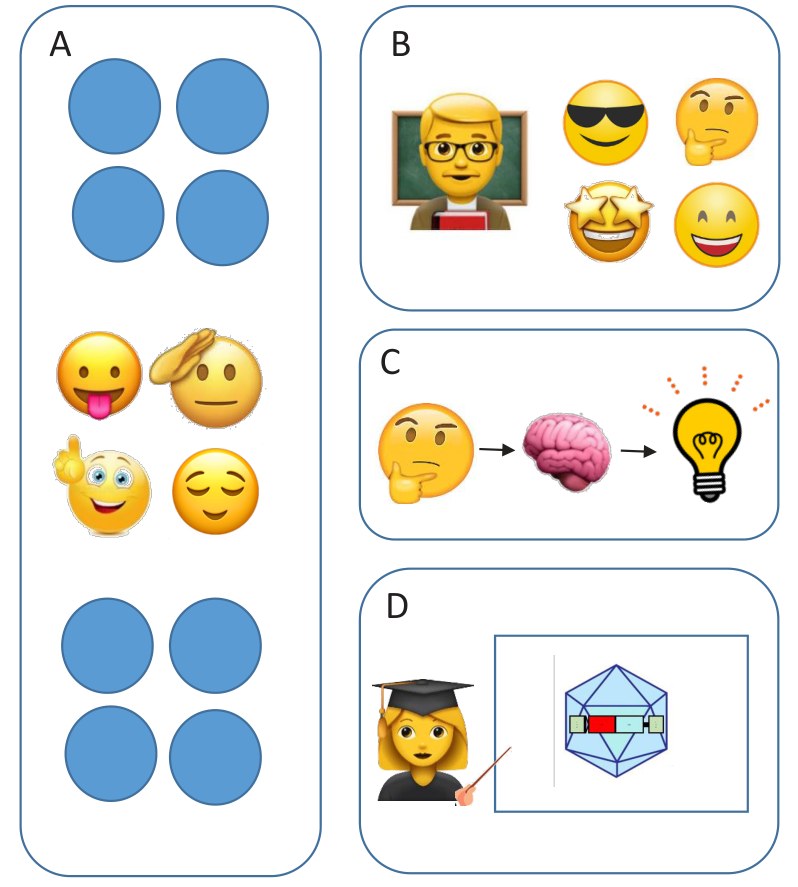
Fig. 1. Four essential elements for effective teaching and learning: A. Small group teaching. B. Casual staff to support students. C. Active learning strategies. D. Quality teaching materials.
1. Small Group Learning
Small group teaching plays an important role in supporting effective student learning.
During online teaching, educators frequently encountered classes in which students were reluctant to activate their cameras or microphones.
Rather than engaging in discussion, many students remained represented only by their profile icons, occasionally contributing a brief comment through the chat function.
Large classes can make participation particularly difficult, even when the group contains only approximately 30 students.
In contrast, students often express a preference for working in much smaller groups of two to four people.
These smaller groups create opportunities for more meaningful interaction, encourage students to contribute and make it easier for individuals to ask questions.
Online breakout rooms can support this type of engagement in much the same way that small group activities work in face-to-face classrooms.
Regardless of the teaching environment, providing opportunities for students to collaborate in manageable groups can strengthen participation and learning.
2. Learners Need Support – Casuals Are Essential
Effective teaching depends on the contribution of the entire teaching team, including casual teaching assistants, tutors and laboratory demonstrators.
These staff members provide valuable support to students and are closely connected to the quality of their learning experiences.
Although small group teaching can encourage greater participation, some students remain hesitant to contribute.
Students may be nervous about answering incorrectly, lack confidence in their understanding or feel disengaged from the subject.
Educators need to create environments in which students feel comfortable exploring unfamiliar concepts and acknowledging areas they do not yet understand.
Academic staff and casual teaching assistants play an important role in achieving this by actively engaging with students during small group activities.
Their involvement can help students develop confidence, participate more fully and work through challenging material.
Supporting the staff who facilitate these learning experiences is therefore an essential part of supporting students themselves.
3. Long Lectures Can Be Boring
Active learning strategies can improve student engagement across lectures, tutorials and other teaching activities.
Long lectures that require students to listen passively while processing large amounts of information can make it difficult to maintain attention.
During discussions about teaching design, I was reminded that an individual's attention span can be surprisingly short, particularly when they are expected to absorb complex information without opportunities to participate.
In 2020, I redesigned lectures that had sometimes lasted as long as two hours, dividing the content into smaller sections of approximately 20 minutes.
This approach made the material more manageable and helped maintain students' interest.
I also revisited active learning strategies that encouraged students to do more than simply observe or listen.
By incorporating opportunities for participation, educators can help students engage more directly with the subject material.
Active learning encourages students to become contributors to the learning process rather than passive recipients of information.
The lessons learned from redesigning lectures for online delivery can therefore be carried forward into face-to-face teaching.
4. Quality Teaching Materials Require Ongoing Development
Clear, informative teaching materials can significantly improve students' understanding of complex concepts.
Presentations containing large amounts of text, particularly when educators simply read the slides aloud, can discourage engagement and make learning less effective.
During 2020, the transition to remote delivery encouraged educators to reconsider how their teaching resources were designed and presented.
Learning materials were rapidly adapted to incorporate different forms of media, including animations, demonstrations and visual explanations.
However, effective resources do not necessarily require elaborate technology or sophisticated graphics.
A small number of carefully chosen images, accompanied by clear explanations, can often communicate scientific concepts more effectively than slides containing extensive written information.
This is particularly important in biochemistry and molecular biology, where many concepts are inherently visual.
Molecular structures, cellular processes and biochemical mechanisms can be difficult to understand without appropriate visual representations.
Regularly reviewing and improving teaching materials can therefore make a meaningful difference to students' comprehension.
Continuing to develop resources, rather than relying on materials that remain unchanged from year to year, helps educators communicate scientific ideas more clearly.
Looking Ahead
The experience of moving between face-to-face and online teaching has provided valuable opportunities to reflect on what makes teaching effective.
Although remote learning presented significant challenges, it also encouraged educators to revisit established teaching practices and identify opportunities for improvement.
Small group learning, active support from teaching staff, interactive learning activities and well-designed resources remain important regardless of how teaching is delivered.
As universities return to face-to-face classrooms and laboratories, the lessons learned from online teaching can be incorporated into future teaching practices.
These improvements have the potential to benefit students, educators and teaching teams alike.
While these four elements were particularly significant in my experience, the broader transition has prompted educators to reflect on many aspects of their teaching.
Sharing these reflections may help us continue improving how biochemistry and molecular biology are taught.
About the Author

Dr Nikki Curthoys is a Lecturer in the School of Chemistry and Molecular Bioscience at the University of Wollongong.
ncurthoy@uow.edu.au
This article first appeared in the ASBMB Education Feature of Australian Biochemist , Vol 52 No 1, April 2021, pages 21–22.
ASBMB Membership Office
T +61 (03) 9907 8648
E asbmb@wsm.com.au
© 2026 ASBMB. All rights reserved.