The Student Perspective: Advice from Students on What Teaching Academics Should Take With Them From the Pandemic
Amber Willems-Jones (University of Melbourne) and Tracey Kuit (University of Wollongong) talk to undergraduate biochemistry students Ishika Jaitly, Marcus Go, Darlene Sentosa and Janelle Accheni.
At the ComBio22 Education Symposium, undergraduate students from several Australian universities participated in a panel discussion reflecting on their experiences of university learning during the COVID-19 pandemic.
The panel included Marcus Go, a third-year Bachelor of Science student from Monash University; Ishika Jaitly, a final-year Bachelor of Medicinal Chemistry student from UNSW; and Darlene Sentosa, a third-year Bachelor of Science student from the University of Melbourne.
Together with Janelle Accheni, a second-year Bachelor of Science student from Deakin University, the students discussed the benefits and difficulties of online learning, what they had discovered about themselves, and which lessons educators should carry forward into post-pandemic teaching.
What positive or negative learning experiences stand out in your time as an online learner during the pandemic?
Ishika: One of the most valuable aspects of online learning was the opportunity to participate in interactive activities using platforms such as Slido and Kahoot. Live polls and quizzes encouraged students to remain engaged while allowing educators to check understanding immediately.
These activities made learning more participatory and helped reinforce the concepts being taught. Involving students actively in the learning process was far more effective than simply presenting information.
Janelle: As a mature-age student, I appreciated the opportunities to connect with other students through online study groups and discussion forums. Recorded teaching materials were also extremely useful because I could revisit explanations and strengthen my understanding.
However, the lack of face-to-face laboratory classes was a significant disadvantage. Many students in my cohort had little or no opportunity to develop practical skills during the pandemic.
When we eventually returned to campus, valuable laboratory time was spent learning basic equipment-handling techniques rather than concentrating on the experiments themselves. This was frustrating for students and demonstrators, and I still feel that my practical skills have been affected.
Darlene: The limited interaction between students and academics was a major challenge. Even when online breakout rooms were available, they did not always provide the same opportunities for meaningful communication and collaboration.
This isolation could affect both academic performance and mental wellbeing. I also found the absence of hands-on laboratory experience difficult because it was harder to visualise experimental procedures without seeing or performing them.
Marcus: One of the biggest disadvantages was losing the opportunity to form relationships with classmates through physical lectures and campus activities.
Online learning created a barrier between students, making it more difficult to establish friendships and support networks. These connections are important not only for academic study but also for maintaining wellbeing.
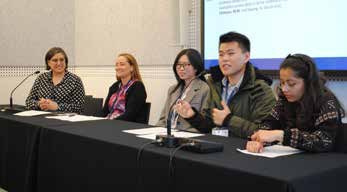
Student panel discussion at ComBio2022.
Can you describe what you learned about yourself through the online learning experience during the pandemic?

Biochemistry students, from left: Janelle Accheni, Marcus Go, Ishika Jaitly and Darlene Sentosa.
Darlene: As an international student living away from home, the sudden transition to online study was especially difficult and affected my physical and mental health.
After returning to Indonesia for a semester of online learning, I became more independent and developed a more thoughtful approach to studying. Rather than relying on memorisation, I began preparing more thoroughly and working towards a deeper understanding of the material.
The experience also encouraged me to discover which study methods worked best for me and to think carefully about my future career. Although the pandemic was challenging, it contributed significantly to my personal development.
Marcus: During my first year at university, I approached examinations largely through memorisation. My goal was to retain enough information to perform well in assessments.
When learning moved online, that strategy became less effective. I gradually shifted towards understanding the principles behind the material, asking questions and thinking more critically.
Once I changed my approach, I became more confident in my understanding and performed better in examinations.
Ishika: Looking back, the pandemic provided an opportunity to discover my ability to manage difficult circumstances.
Adjusting to independent study, online examinations, homesickness and social isolation was demanding, but overcoming these challenges strengthened my resilience.
I now feel better prepared to respond to unexpected changes and to approach future difficulties with confidence.
Janelle: I learned how important it is to protect my mental health and remain adaptable.
Initially, I believed I was managing the demands of studying online, working remotely and caring for others. Over time, however, balancing these responsibilities became increasingly difficult.
Taking a leave of absence allowed me to recover, reconsider my priorities and return to university with a healthier and more focused approach to studying.
Is there a piece of advice you would like to give your teaching academics as they move into the post-pandemic future?
Ishika: Universities should place greater emphasis on building a sense of community among students learning online.
Group projects, regular tutorial discussions and purposeful breakout-room activities can help students establish connections and participate more actively.
Clear communication between academics and students is equally important. Virtual consultation hours, weekly lists of required learning activities and regular check-in surveys can help students organise their time and stay accountable.
These relatively simple initiatives can also give teaching staff a clearer understanding of students' progress and the demands on their time.
Darlene: Online learning will continue to be part of university education, but educators need to be thoughtful about how it is incorporated.
Online activities should enhance and support teaching rather than simply replace meaningful interactions with academics.
Independent modules and assignments can be useful, but they should complement carefully structured teaching materials rather than become the sole focus of a subject.
Marcus: Creating opportunities for students to connect should remain a priority.
Regular tutorials that encourage peer interaction can strengthen learning while helping students establish friendships and professional networks.
Janelle: Universities should recognise that students have different circumstances, learning preferences and support needs.
Online learning offers valuable flexibility, but its quality must be maintained and there should be an appropriate balance between online and on-campus activities.
Students should not be expected to learn everything independently through online worksheets and modules. Some need additional guidance, structured learning activities and regular interaction with educators.
Flexibility should continue beyond the pandemic. Many students are still experiencing mental health challenges, while others have had little exposure to traditional university learning.
Returning to campus therefore requires a carefully managed transition. An abrupt return to entirely face-to-face learning can be just as challenging for some students as the original transition online.
Is there a piece of advice you would like to give a fellow student as they transition into the post-pandemic future?
Marcus: Explore the range of subjects and learning opportunities available throughout your degree.
Research projects, internships and practical experiences can help develop transferable skills and demonstrate how theoretical knowledge applies in professional settings.
Electives outside your major can also introduce new interests and different approaches to solving problems.
Because the pandemic disrupted important aspects of university learning and the transition into employment, gaining practical experience and developing a broad range of skills is particularly valuable.
Darlene: Don't hesitate to ask lecturers and tutors questions, even when they are not directly related to the current week's content.
Where possible, organise your timetable to take advantage of face-to-face learning opportunities, especially for subjects involving practical work.
At the same time, remain flexible. Online classes can be an excellent option when attending campus is difficult, particularly for subjects that do not require hands-on activities.
Ishika: Adaptability is one of the most important qualities students can develop.
The pandemic demonstrated how quickly circumstances can change. Approach university with an open mind, a willingness to work hard and the confidence to embrace unfamiliar challenges.
Janelle: Prioritise your wellbeing and seek help when you need it.
Make use of university support services and maintain a strong network of people outside your studies.
Identify the learning approaches that work best for you and choose subjects that suit your circumstances while meeting the requirements of your degree.
Don't be afraid to approach academic staff for assistance. Practical classes are also worth prioritising because they help build important skills that can be transferred into future employment.
Above all, make the most of your university experience and enjoy the opportunities it provides.
Responses to questions have been paraphrased and condensed with permission.
About the authors

Dr Amber Willems-Jones is a Senior Lecturer in the Department of Biochemistry and Pharmacology, University of Melbourne.
amber.willems@unimelb.edu.au

Tracey Kuit is an Education-Focused Associate Professor in the School of Chemistry and Molecular Bioscience, University of Wollongong.
tracey_kuit@uow.edu.au
This article first appeared in the ASBMB Education Feature of Australian Biochemist Vol 53 No 3, December 2022, pages 23–25.
ASBMB Membership Office
T +61 (03) 9907 8648
E asbmb@wsm.com.au
© 2026 ASBMB. All rights reserved.